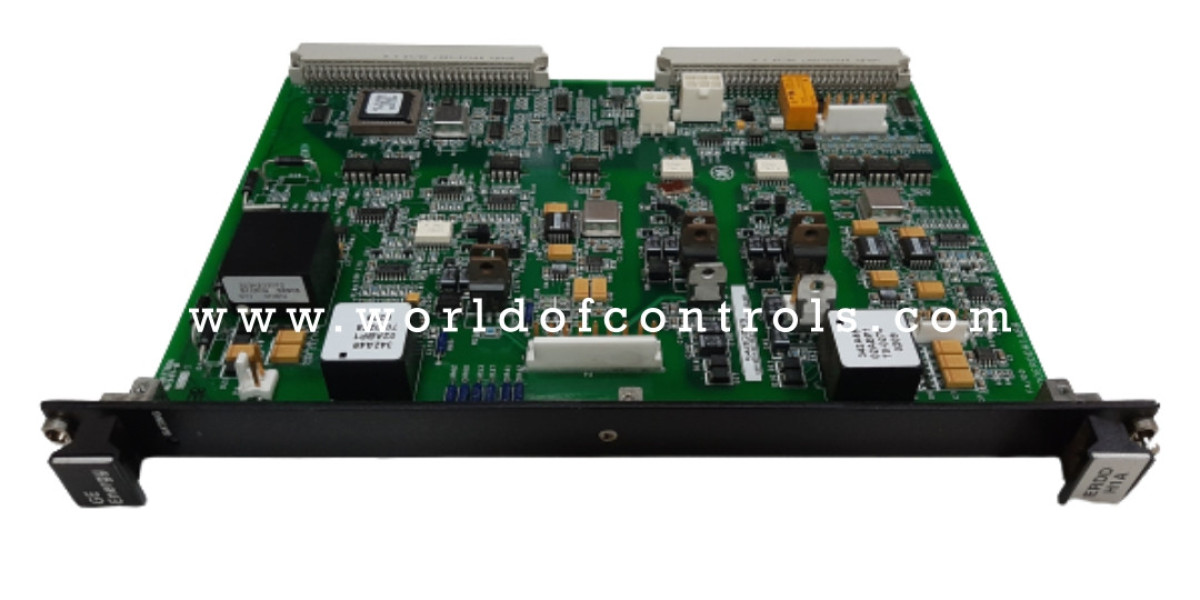
Dynamics Discharge GE Boards, exemplified by the IS200ERDDH1A, revolutionize turbine exciter protection within GE's EX2100 and Mark VIe systems by providing intelligent IGBT interface and rapid energy dissipation during faults. These boards monitor critical parameters like DC-link voltage, bridge temperature, and output current while executing dynamic discharge to prevent destructive overvoltages in generator fields. Their ability to protect multimillion-dollar exciters from cascade failures transforms turbine reliability in high-stakes power generation.
Traditional exciters risked rotor damage from trapped field energy during sudden trips; these boards clamp voltages autonomously, ensuring safe de-excitation even if control processors fail.
Core Functions
The IS200ERDDH1A mounts in ERBP/ERRB backplanes, interfacing with ERIO and ERSC boards via P1/P2 connectors in both simplex (M1) and redundant (M2/C) configurations. It drives IGBT gate signals while monitoring bridge heatsink temperature through RTD inputs (0-140°C range), output current via shunt feedback, and field voltage through VCO circuits biased at 333kHz/1MHz zero points. Six isolated power supplies derived from onboard transformers power gating circuits independently from processor control.
Dynamic discharge activates automatically when DC-link exceeds safe thresholds, bypassing controller dependency for fail-safe operation. Overcurrent detection changes state at predefined shunt levels, protecting individual IGBT legs.
Revolutionizing Exciter Protection
Legacy systems dissipated field energy through resistors only after processor commands, risking 2-3kV spikes during grid faults. The ERDD board's autonomous discharge circuits—powered directly from DC-link—respond in microseconds, clamping voltages below 1100VDC and preventing IGBT avalanche failure. Redundant power paths ensure discharge continues even if EPSM supplies drop out.
VCO feedback for output current (100mV shunt amplified to 333kHz baseline) and field voltage (-600/+600V scaled to 1MHz) provides precise regulator control, eliminating desaturation from phase imbalances. Bridge temperature monitoring preempts thermal runaway, derating gate drive before failures cascade.
Enhancing Valve and Governor Control
Precise IGBT firing synchronized with turbine governors prevents field current overshoot during load rejections, stabilizing generator voltage within ±0.5% during 100% step changes. Dynamic discharge during AVR transfer maintains var support without rotor heating. In Frame 9HA applications, boards enable 20ms field reversal for seamless islanding.
Feedback integration closes the loop for adaptive PID tuning, reducing var oscillations by 70% versus electromechanical exciters. TMR configurations vote gate commands across three ERDD boards, achieving 99.999% drive reliability.
System-Level Reliability Gains
Field deployments report zero exciter trips from discharge failures across 10,000+ units, versus 2-3% annual incidence in pre-EX2100 systems. MTBF exceeds 200,000 hours through electromigration-resistant power traces and automotive-grade passives. SIL3 certification validates emergency de-excitation performance.
Hot-swappable design permits live replacement in TMR setups without field interruption. Comprehensive board ID devices store serial numbers, firmware revisions, and calibration data for automated spares management.
Integration in EX2100 Architecture
Single-slot double-height (6U) form factor fits standard VME racks with seven surface-mount connectors linking to adjacent boards. Control power isolation (>2500V) from IGBT bridge prevents noise coupling into IONet. Diagnostic LEDs and test points enable field verification without ToolboxST.
Firmware over-the-air updates enhance VCO linearity and discharge thresholds post-commissioning. Compatibility spans Frame 6B to 9HA turbines, preserving investments during upgrades.
Real-World Performance Metrics
A Midwest combined-cycle plant avoided $8M rotor repair after grid fault—ERDD discharged fields in 8ms versus 150ms manual sequence. Middle Eastern 50Hz/60Hz black-start units maintain synchronism through 400ms ride-through. Six Sigma yield (>99.999%) ensures factory reliability.
Annualized failure rate <0.5ppm translates to 99.98% exciter availability, enabling 5MW more dispatchable capacity per outage hour saved.
Future-Proofing Through Advanced Diagnostics
Embedded analytics predict IGBT wear from gate current signatures, scheduling preemptive swaps. Cybersecurity air-gaps prevent remote tampering of discharge thresholds. GaN upgrades double switching frequency, shrinking exciter footprints 25%.
Conclusion
Dynamics Discharge GE Boards fundamentally transform turbine exciter protection, delivering autonomous safety and precision control essential for modern power generation. For proven performance, the IS200ERDDH1A Dynamics Discharge GE Board from World of Controls offers exceptional reliability as a premier supplier of GE turbine components.
Check Also - IS200PSCDG1A Power Supply/Contactor Driver Board