
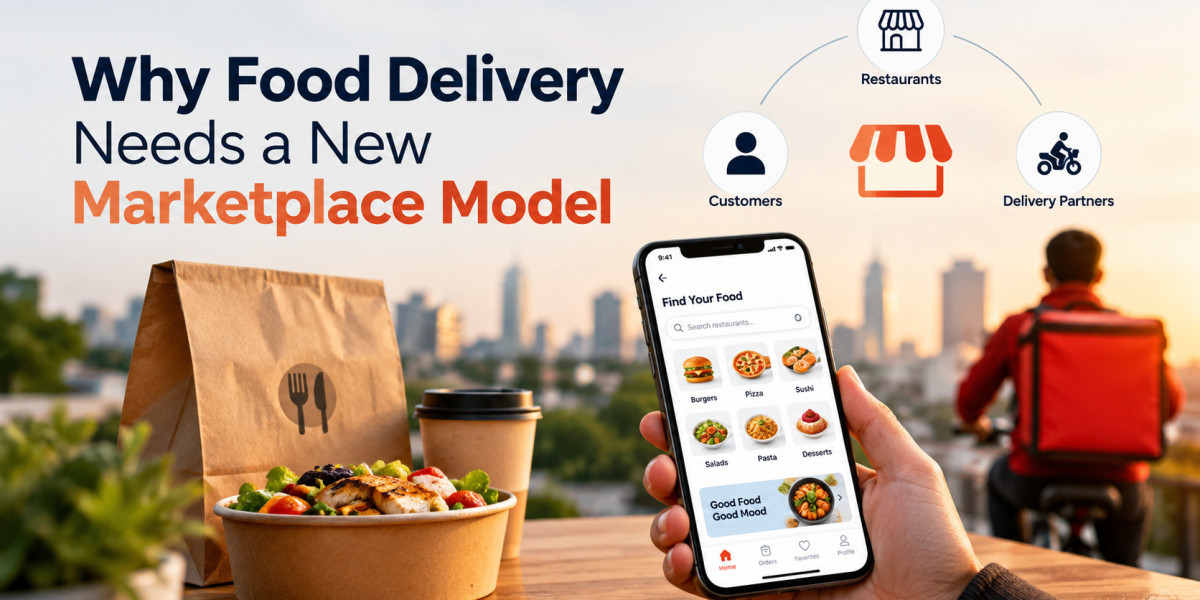
The next food delivery opportunity may not be about becoming the biggest marketplace. A DoorDash clone can be used to build a more focused model—one designed around order economics, restaurant relationships, delivery density, and customer retention instead of simply accumulating listings.
That shift matters because food delivery has entered a more mature phase. Adding another restaurant to an app is relatively easy. Generating profitable, repeat orders while keeping restaurants and delivery partners engaged is considerably harder.
For entrepreneurs entering this space, the interesting question is no longer, “How can we build another delivery app?”
It is:
“What part of the food-ordering market can we operate better?”
DoorDash Clone and the New Marketplace Equation
Large food platforms benefit from scale, but scale also creates operational complexity. A marketplace serving thousands of restaurants across wide geographic areas has to balance delivery distances, driver availability, peak-hour demand, promotions, refunds, and customer expectations simultaneously.
A new operator does not necessarily need to replicate that footprint.
A more targeted DoorDash clone could be built around high-density micro-markets. Think business districts during lunch hours, university areas, residential communities, regional restaurant clusters, or specific cuisine categories.
Why does density matter?
When orders are concentrated geographically, delivery operations can become easier to coordinate. Restaurants get access to relevant local demand, while customers see more useful choices within a manageable delivery radius.
This creates an alternative growth path:
Own a niche → build order density → improve operations → expand the territory.
That is very different from launching everywhere and hoping volume follows.
Restaurant Economics Are Changing the Platform Opportunity
Restaurants are also becoming more deliberate about their digital channels.
Many food businesses don't want their entire online demand strategy to depend on third-party marketplaces. They want greater visibility into customer behavior, stronger retention opportunities, and more flexibility around promotions.
This creates an interesting opening for marketplace operators.
A modern food delivery marketplace can provide restaurants with more than a digital menu. Promotional campaigns, customer segmentation, loyalty programs, sponsored visibility, direct ordering options, and performance insights can become part of the commercial relationship.
For a startup, this changes the restaurant pitch.
Instead of saying:
“Join our delivery app.”
The proposition becomes:
“Use our marketplace to reach incremental local demand while gaining more ways to engage customers.”
That difference can influence restaurant acquisition and retention.
On-Demand Delivery Is Becoming an Operations Problem
Consumer expectations continue to move toward faster fulfillment and greater visibility. But promising increasingly short delivery times can create pressure on unit economics.
This is where technology decisions become business decisions.
A DoorDash clone can support different operating models rather than forcing one universal delivery strategy. Scheduled delivery, zone-based fulfillment, batching, minimum order thresholds, variable service fees, and restaurant-specific delivery arrangements can all be considered depending on the market.
For example, a marketplace operating in a dense urban area might prioritize rapid dispatch, while a suburban operation could use scheduled delivery windows to improve route efficiency.
The platform should accommodate those differences.
The goal isn't simply more deliveries.
It is better economics per delivery.
AI Won't Replace Marketplace Strategy
AI is becoming increasingly relevant across food delivery—from recommendation engines and demand forecasting to automated support and delivery allocation.
But there is a misconception that adding AI automatically creates a competitive marketplace.
It doesn't.
If the marketplace has weak restaurant supply, scattered demand, excessive delivery distances, or poor customer retention, automation simply makes an inefficient model operate faster.
AI becomes more valuable once the underlying marketplace has useful data and sufficient transaction activity.
That makes the initial market strategy even more important.
A focused DoorDash clone can begin by collecting meaningful signals about ordering patterns, restaurant performance, peak periods, delivery zones, and customer preferences. Those signals can later support smarter recommendations, promotions, and operational decisions.
Build for a Specific Market Before Building for Scale
The strongest opportunity for a new food delivery business may be hiding in markets that major platforms don't serve with the same depth.
Regional restaurant ecosystems, specialized cuisine communities, smaller cities, corporate food programs, and hyperlocal delivery networks can each support different marketplace models.
A DoorDash clone App provides the technical foundation, but the differentiation comes from what happens around it.
SpotnEats helps businesses develop customizable food delivery platforms that can be structured around their chosen market, restaurant strategy, delivery operations, and revenue model.
Instead of treating the established food delivery model as something to copy exactly, entrepreneurs can use it as a starting framework—and then build around a market opportunity that larger platforms may not fully address.
The opportunity isn't to build another delivery app. It's to build a food marketplace with economics and positioning that make sense for your market.
Ready to explore that model? Connect with SpotnEats to discuss your food delivery marketplace strategy.






