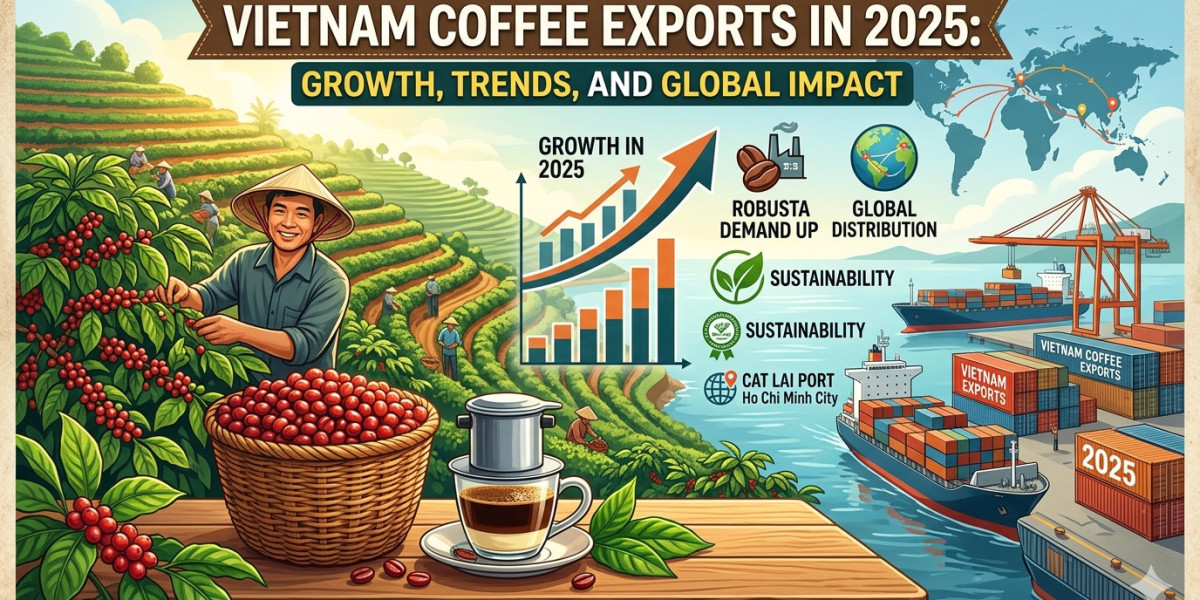
Vietnam has firmly established itself as a powerhouse in the global coffee industry. Over the past decade, the country has transformed from a regional producer into one of the world’s most influential exporters of coffee. Backed by strong agricultural practices, favorable climate conditions, and a growing network of global trade partners, Vietnam coffee exports have reached unprecedented heights in recent years.
According to Vietnam customs data, the country recorded coffee export revenues of $5.62 billion in 2024, marking a 12% increase compared to the previous year. This remarkable growth highlights Vietnam’s resilience and adaptability in the global market, especially during periods of fluctuating supply and rising prices.
As we move into 2025, the outlook remains highly positive. With export values expected to touch $7 billion, Vietnam coffee exports continue to play a crucial role in shaping global coffee trade dynamics.
Record-Breaking Performance of Vietnam Coffee Exports
The year 2025 has already demonstrated strong momentum for Vietnam’s coffee sector. In the first five months alone, export revenues reached approximately $4.7 billion, driven by high global demand and record-breaking prices.
Despite a slight decline in export volumes due to lower production in the previous season, export value surged significantly. This trend reflects a key shift in the market—where higher prices compensate for reduced supply. The average export price climbed to over $5,700 per ton, representing a substantial increase compared to previous years.
This price-driven growth has positioned Vietnam coffee exports as a high-value segment within the agricultural export sector. It also highlights the country’s ability to capitalize on global market conditions, particularly during supply shortages in other major coffee-producing nations.
Vietnam Coffee Production and Industry Landscape
A critical factor behind the success of Vietnam coffee exports is the country’s strong production base. Vietnam is currently the second-largest coffee producer in the world, after Brazil, and the largest producer of Robusta coffee.
Vietnam coffee production is concentrated in key regions such as Dak Lak, Lam Dong, and Gia Lai. These areas benefit from ideal soil and climatic conditions, enabling consistent and high-quality output. Coffee farming supports millions of livelihoods, with smallholder farmers contributing significantly to the supply chain.
Robusta beans dominate the industry, accounting for around 95% of total output. Known for their bold flavor and higher caffeine content, these beans are widely used in instant coffee and espresso blends. Arabica production, although smaller, is gradually gaining attention due to increasing global demand for premium coffee.
In 2024, total coffee production stood at approximately 1.74 million tons. However, adverse weather conditions, including drought, led to a decline in output during the 2023–2024 season. Despite this, improved rainfall in early 2025 is expected to support recovery, with production projected to grow by 7% in the 2025–2026 season.
Key Export Markets Driving Growth
The success of Vietnam coffee exports is closely linked to its strong global trade partnerships. Europe remains the largest market, with countries like Germany, Italy, and Spain leading imports.
Germany alone accounts for nearly 15% of total exports, making it the top destination. The United States follows closely, with increasing demand driven by competitive pricing and growing consumer interest in Vietnamese coffee.
Other important markets include Japan, South Korea, and the Philippines, where demand is rising steadily. Asia, in particular, is emerging as a key growth region, offering higher price premiums compared to traditional markets.
This diversification of export destinations has strengthened Vietnam’s position in global trade and reduced dependency on any single market. It also reflects broader trends in Vietnam exports, where agricultural commodities are increasingly targeting high-growth regions.
Leading Vietnam Coffee Exporters
Behind the rapid expansion of Vietnam coffee exports is a network of well-established companies that have built strong international reputations. These Vietnam coffee exporters play a vital role in connecting domestic production with global markets.
Top exporters such as Intimex Group, Vinh Hiep Co., Ltd, and Nestlé Vietnam lead the industry with significant export volumes and strong distribution networks. Other key players include Olam Vietnam, Louis Dreyfus Vietnam, and Simexco Daklak.
These Vietnam coffee exporters are not only focused on volume but are also investing in quality improvement, sustainability, and value-added products such as roasted and soluble coffee. Their efforts are helping Vietnam move up the value chain and compete with premium coffee producers worldwide.
As global competition intensifies, the role of Vietnam coffee exporters becomes even more critical in maintaining quality standards, ensuring supply chain efficiency, and adapting to market trends.
Export Trends: Value Over Volume
One of the most notable trends in 2025 is the divergence between export volume and value. While shipment volumes have declined due to lower production, export revenues have increased sharply due to rising prices.
For instance, between January and April 2025, Vietnam exported approximately 665,000 tons of coffee, generating $3.8 billion in revenue. This represents a nearly 52% increase in value despite a decline in volume.
This trend underscores the growing importance of pricing dynamics in Vietnam coffee exports. It also highlights the need for exporters to adopt flexible strategies, including price hedging and contract optimization.
Additionally, farmers are increasingly holding back stock in anticipation of further price increases. This behavior is influencing supply patterns and adding complexity to the global coffee market.
Impact of Tariffs and Trade Policies
Trade policies have also played a significant role in shaping the trajectory of Vietnam coffee exports. In 2025, the United States imposed a 46% tariff on Vietnamese Robusta coffee, creating new challenges for exporters.
In response, Vietnam has shifted its focus toward alternative markets such as the European Union and Asia. Free trade agreements, including the ASEAN-India FTA, provide tariff advantages and open new opportunities for expansion.
These developments highlight the importance of strategic planning in Vietnam exports, where geopolitical factors can significantly impact trade flows.
Value-Added Coffee and Future Opportunities
A key growth area for Vietnam’s coffee industry is value-added products. Processed coffee, including roasted and soluble variants, is gaining traction in international markets.
Currently, processed coffee accounts for nearly 9.6% of total exports, with projections indicating further growth in the coming years. This shift aligns with global consumer preferences for convenience and premium quality.
For Vietnam coffee exporters, investing in processing capabilities and branding presents a significant opportunity to increase profit margins and strengthen global competitiveness.
Challenges and Risk Factors
Despite its strong performance, the industry faces several challenges. Climate change, fluctuating prices, and geopolitical tensions continue to pose risks to Vietnam coffee production and exports.
Weather conditions remain a critical factor, as seen in the production decline during the 2023–2024 season. Additionally, market volatility and changing trade policies require constant adaptation.
Access to reliable Vietnam customs data is essential for businesses to navigate these challenges effectively. Data-driven insights enable exporters to identify trends, optimize strategies, and make informed decisions.
Future Outlook of Vietnam Coffee Exports
Looking ahead, the future of Vietnam coffee exports appears highly promising. With production expected to recover and global demand remaining strong, the industry is well-positioned for sustained growth.
The projected increase in export volume to 27 million bags in the 2025–2026 season reflects positive momentum. At the same time, continued investment in quality, sustainability, and innovation will be key to maintaining competitiveness.
As Vietnam coffee exporters expand their global footprint, the country is likely to strengthen its position as a leading player in the international coffee market.
Conclusion
Vietnam’s coffee industry has entered a new phase of growth, driven by strong global demand, rising prices, and strategic market diversification. The impressive performance of Vietnam coffee exports in 2025 highlights the country’s ability to adapt and thrive in a dynamic global environment.
With a solid foundation in Vietnam coffee production, a growing network of international partners, and a focus on value-added products, Vietnam is set to remain a dominant force in the global coffee trade.
For businesses and investors, leveraging insights from Vietnam customs data and understanding evolving market trends will be essential to capitalize on the opportunities within this thriving sector.