A 2025 J.D. Power study found that failure rates improved from 19% to 14% between 2024 and 2025. Even this reduced failure rate means that one in seven charging attempts still fails.
In a network running hundreds of stations across multiple sites, that figure is not a statistic. It is a revenue problem, a customer trust problem, and an operational cost problem compounding simultaneously.
Autonomous charger recovery, powered by modern EV charging station software, is the structural answer the industry has been building toward.
The Real Cost of Reactive Maintenance
Before understanding what autonomous charger recovery saves, it is worth being precise about what reactive maintenance costs.
One of the biggest mistakes businesses make is treating EV charging station failures as isolated repairs.
- As commercial workplace EV charging infrastructure expands, even a single charger outage can delay fleet operations, inconvenience employees, and impact customer experience.
- The direct costs are visible and easy to quantify. Commercial operators should expect to budget around $500 per charger annually, though exact costs vary by charger type and usage.
- Environmental exposure, high utilisation, and the complexity of networked features can increase maintenance needs and associated costs.
- For a CPO running 200 stations, that baseline figure alone represents a six-figure annual maintenance budget before emergency callouts, expedited parts shipping, or overtime labour are factored in.
Quick, reactive repairs when issues do occur help maintain a good user experience and keep drivers coming back to your stations.
What Autonomous Charger Recovery Actually Does
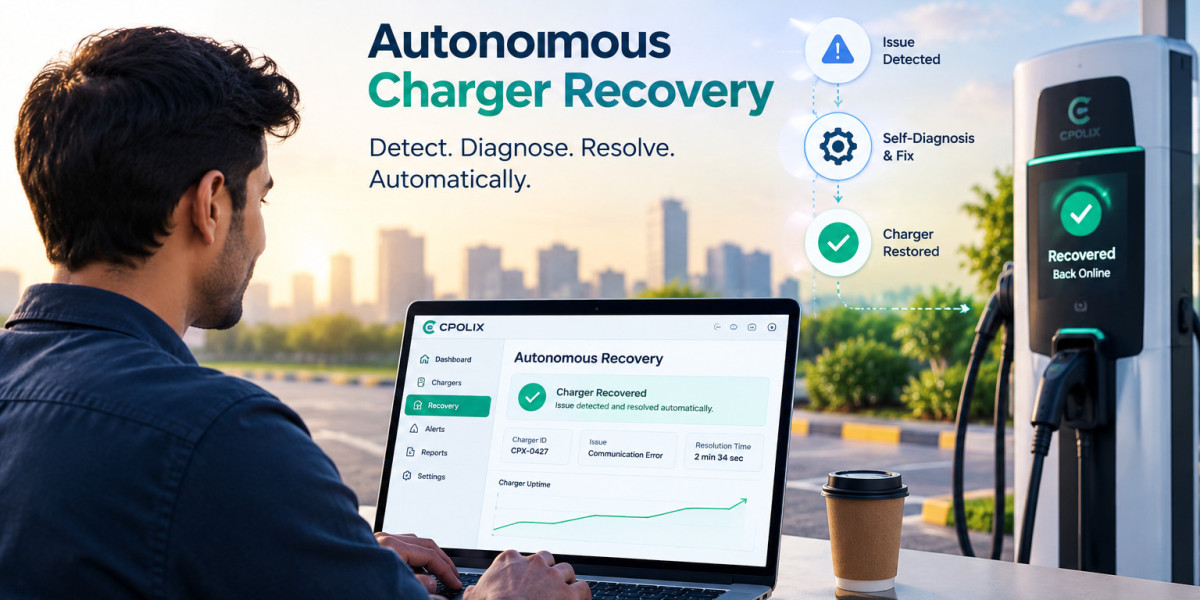
Autonomous charger recovery is the capability within EV charging station software to detect, diagnose, and resolve charger faults without human intervention.
The mechanism works across three distinct layers:
Detection
The EV charging station software continuously monitors every connected charger across the network, ingesting live data from OCPP feeds on session performance, voltage behaviour, connectivity status, thermal conditions, and hardware health.
Anomalies that fall outside normal operating parameters, even subtle ones that would not trigger a conventional alert, are flagged instantly by machine learning models trained on historical fault patterns.
Diagnosis
Once an anomaly is detected, the system classifies it. Is this a connectivity fault? A firmware issue? A thermal irregularity trending toward hardware failure? A session error that can be resolved with a remote reset? The diagnosis determines the resolution pathway, and for most common faults, that pathway requires no human intervention.
Recovery
Remote resets, firmware pushes, configuration updates, session restarts, and load redistribution are all triggered through the software without operator input. Smart alert and self-recovery systems nearly eliminate the need for human maintenance, featuring automatic infrastructure diagnostics and autonomous fault-recovery algorithms for efficient operation.
By the time a technician arrives on site, they already know exactly what is wrong and what they need to fix it. Resolution time drops dramatically.
What EV Charging Station Software Needs to Make This Work
Not all EV charging station software is built with autonomous recovery capability. The platforms that deliver genuine, measurable maintenance cost reductions share a common set of architectural requirements:
- Real-time OCPP data ingestion: Full OCPP 1.6J and 2.0.1 compliance is non-negotiable. The software needs live, bidirectional communication with every charger in the network to detect anomalies.
- Machine learning fault models: Rule-based alert systems catch faults that cross predefined thresholds. Machine learning models catch the subtle, early-stage patterns that precede those thresholds, enabling recovery before the fault becomes visible to a conventional monitoring system.
- Trigger-driven API execution: Autonomous recovery requires the ability to act, not just observe. The software must be capable of executing remote commands, resets, configuration changes, and firmware updates through secure, trigger-driven APIs without human initiation.
- Agentic AI ticketing: For faults that require physical intervention, the system must generate structured, pre-diagnosed tickets automatically and route them to the right team member with full context already captured. Manual ticket creation is a bottleneck that autonomous systems eliminate entirely.
The Operational Shift That Changes Everything
In 2024 alone, more than 1.3 million public charging points were installed globally, highlighting the rapid growth of EV infrastructure. As networks scale, the maintenance challenge scales with them.
Autonomous charger recovery is not a feature that makes a good network slightly better. It is the capability that makes large-scale network operations financially sustainable. Making the transition from reactive to proactive maintenance not just an opportunity, but a competitive necessity for CPOs seeking sustainable profitability.
They are building networks that scale without proportional increases in operational cost and that competitive advantage compounds every year as their network grows and their software gets smarter.
The question was whether autonomous charger recovery can reduce EV charging maintenance costs.
The data says yes. The mechanism is clear. The only remaining variable is how long a CPO waits before making it part of their operational infrastructure.