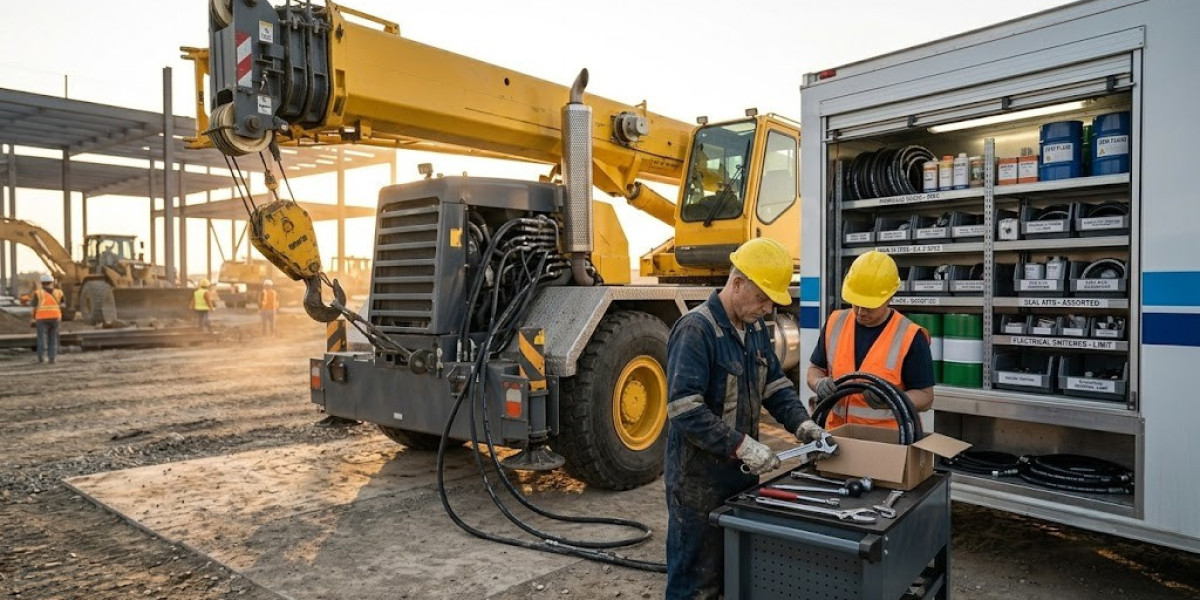
Money spent on crane parts is either planned or it is painful. Fleet managers who approach parts budgeting with discipline find that maintenance costs become manageable, predictable line items. Those who rely on gut feeling find themselves explaining overruns to executives who do not care about hydraulic theory.
The difference lies entirely in preparation. A structured budgeting process converts unknown future costs into a roadmap you can follow with confidence.
Grove cranes hold up under punishing operating conditions, but they still require consistent component renewal. Every filter, hose, bearing, and wire rope has a useful life defined by the hours it spends in service. Building a budget that respects these limits — and adjusts for the variables that affect them — is the core challenge. Here is how to approach it systematically.
Project Operating Hours for Each Crane
No maintenance forecast is credible without first establishing how much each machine will work over the coming year.
Visit every crane and record the current hour meter reading. This is hands-on data collection that cannot be done remotely. Once you have accurate readings, estimate the hours each unit will accumulate next year based on contracted projects, historical utilization, and realistic assessments of market demand. A crane under a multi-year agreement offers predictability. One used for occasional specialty work requires a more conservative estimate.
Parts wear correlates directly with operating time. That oil filter will need replacement after 250 hours regardless of how those hours distribute across the calendar. Wire rope reaches its replacement threshold after a defined number of load-bearing hours. Every scheduled maintenance event in your budget depends on having a defensible hour projection as its starting point.
Break Expenses into Functional Categories
A single aggregate line for parts spending provides no useful information for managing the budget. Dividing costs into categories reveals the structure of your spending and enables better control.
Consumable items represent the first category. Filters, grease, and lighting components are purchased in steady quantities throughout the year. Last year's records, adjusted for volume changes and a standard inflation factor, give you a reliable estimate.
Planned replacements form the second category. Wire ropes, sheaves, swing circle bearings, and various seals have documented service lives that require scheduled renewal. These are not emergency expenditures. They are anticipated purchases timed to prevent in-service failures and their associated safety risks.
Unplanned failures constitute the third category. A solenoid valve fails without notice. A pressure switch stops functioning. Individual events resist prediction, but the historical frequency of such failures allows you to allocate a reasonable reserve. Separating these three categories produces a budget that is easier to construct, easier to explain, and easier to manage.
Review Several Years of Repair Data
Your maintenance archives contain a remarkably accurate forecast of future parts needs, provided you examine them with care.
Gather work orders and repair records from the previous three operating seasons. Examine each parts replacement by component type, machine model, operating conditions, and machine age at the time of failure. Components replaced within the last year are unlikely to require attention again soon. Parts that fail on predictable annual or biennial cycles should be treated as dependable budget entries.
Environmental correlations often become visible during this review. Hydraulic hoses fail disproportionately in cold weather when rubber compounds stiffen. Electrical connectors corrode more rapidly in humid or coastal settings. Starter motors and alternators tend to fail within a common window after roughly three years of service. These patterns emerge only from systematic study of historical records, and they significantly sharpen your forecasting accuracy.
Weight Allocations by Fleet Age
A new crane and a machine with fifteen years of service have fundamentally different parts budgets. Treating them identically produces inaccurate forecasts.
Units under warranty require only routine consumables. Filter changes, fluid services, and basic inspections account for virtually all parts spending. The manufacturer bears the cost of any component that fails prematurely.
Cranes between five and ten years old begin requiring wear-related replacements. Brake components, friction discs, and system seals reach their replacement thresholds during this period. Each item contributes a measurable cost to the annual total.
Beyond ten years, the maintenance cost profile escalates significantly. Electrical wiring insulation becomes brittle from repeated thermal cycles. Hydraulic pump internals wear past serviceable limits. An aging crane may require two to three times the parts investment of a newer machine. Budget allocations that scale with machine age produce forecasts aligned with operational reality.
Map Service Intervals to Projected Hours
Every model in your fleet has a manufacturer-defined maintenance schedule that serves as the engineering foundation of your budget.
Consult the operator's manual for each Grove model you operate. It specifies inspection frequencies for the load block, oil change intervals for gearbox systems, and replacement schedules for boom suspension ropes. These are engineered requirements, not optional suggestions.
Translate each interval into an annual cost by comparing it against your projected hours. If a crane will operate 2,000 hours this year and the gearbox oil is due for service every 1,500 hours, one complete oil change falls within the budget period. Calculate the cost of fluids and filters for that service. Multiply by the number of events and record the result. Performing this exercise across every machine and every scheduled item yields a parts budget rooted in manufacturer specifications rather than assumptions.
Obtain Updated Pricing for Key Components
Several parts on your cranes carry individual costs large enough to warrant dedicated attention during budgeting.
Main hoist motors, hydraulic pump assemblies, and load moment indicator systems each represent a significant single-item expense. Even when replacement is not planned for the coming year, current pricing is essential for accurate multi-year financial planning.
Contact your parts provider for fresh quotes. Pricing in the crane industry trends upward consistently due to material costs, manufacturing overhead, and logistics expenses. A component that cost ten thousand dollars two years ago may now list at twelve thousand. Keeping current pricing documented for Grove crane parts provides advance visibility into large potential expenditures and eliminates financial surprises when the replacement window arrives.
Partner with a Crane-Focused Supplier
Your parts supplier directly influences both your budget accuracy and your ability to maintain uptime when issues arise.
Price stability is the first requirement. When a supplier quotes a figure, you need reasonable assurance that it will remain valid for several months. Constantly fluctuating pricing makes reliable long-range forecasting nearly impossible.
Crane-specific knowledge is the second requirement. A general parts operation will lack the expertise to identify model-specific failure tendencies or recommend appropriate alternatives. Suppliers who focus on crane applications understand which components are prone to failure on particular models and can help you prioritize your critical spares list. HL Equipment, for example, specializes in crane systems and brings model-specific expertise to every conversation about parts needs and inventory planning.
Lead time awareness completes the supplier evaluation. Components requiring weeks to obtain should be stocked proactively. The carrying cost of that inventory is always less than the cost of a machine sitting idle waiting for a part to arrive.
Include a Contingency Reserve
The best-prepared budget will still encounter events that were not anticipated. Equipment operates in unpredictable environments, and damage from external causes is a constant possibility.
Add ten to fifteen percent above your calculated parts total as a contingency buffer. On a budget of one hundred thousand dollars, that means reserving an additional ten to fifteen thousand. This is standard practice among experienced fleet managers and reflects prudent planning rather than overcautious padding.
If the contingency remains unused, it carries forward and strengthens the next year's position. If it is needed, you have immediate resources without seeking emergency authorization. This is particularly valuable when sourcing Grove crane parts under time-critical circumstances, where procurement urgency can create additional costs if you are not financially prepared.
Monitor Actual Spending Monthly
A budget provides no value if it is created at the start of the year and never referenced again. Ongoing tracking is what transforms a forecast into an operational tool.
Each month, compare actual parts expenditures against the budgeted amounts for every category. If a line item is running ahead of the forecast, investigate whether the cause was an unexpected failure, a proactive replacement decision, or a pricing change that was not built into the projection.
Early detection of variances gives you room to take corrective action. You can shift funds from categories with lower-than-expected spending. You can defer non-urgent maintenance on lightly used machines to preserve budget for equipment showing accelerated wear. These adjustments are manageable when made early in the fiscal year and deeply uncomfortable when discovered in November.
Make the OEM Versus Aftermarket Decision Deliberately
Parts sourcing strategy is a budget choice with implications that reach beyond the initial purchase price.
Original equipment components carry higher upfront costs but deliver consistent quality, exact fitment, and manufacturer warranty support. They also help preserve the machine's resale value, which influences total cost of ownership over the equipment's lifecycle.
Aftermarket alternatives offer lower purchase prices, but quality varies widely. A low-cost hydraulic part that fails prematurely triggers a cycle of repeat purchasing, reinstallation labor, and unplanned downtime. The total cost frequently exceeds what the OEM component would have required from the start.
Restrict aftermarket sourcing to non-critical applications where failure has limited operational impact. Cab accessories, wiper assemblies, and cosmetic trim are reasonable candidates. For any system involving structural integrity, hydraulic pressure, or electrical circuits, budget for original equipment or manufacturer-approved alternatives.
Plan for Annual Price Escalation
Parts pricing in the heavy equipment sector consistently trends upward. Raw material costs, labor rates, and transportation expenses all exert pressure on component prices year after year.
Never project next year's costs using this year's pricing without an upward adjustment. A minimum five percent increase across all line items provides a reasonable baseline. For imported components or parts vulnerable to supply chain disruption, a ten percent adjustment may be more appropriate.
Your supplier can often provide advance notice of upcoming manufacturer price increases, which are typically announced months before implementation. Building those expected adjustments into the current budget cycle prevents unwelcome surprises when purchase orders are placed later in the year.
Coming to the Final Number
A credible annual parts budget draws on multiple inputs: projected operating hours, historical maintenance data, manufacturer service intervals, current supplier pricing, and age-based cost differentiation. Assembling these elements into a cohesive document demands thoroughness and attention to detail.
The finished budget is a roadmap you can present with confidence. Every number connects to a documented source. Every allocation rests on a defensible rationale. You can explain the logic behind each line item to decision-makers without hedging.
When a component fails during the year, the financial framework is already in place. Parts are ordered, repairs proceed, and the operation stays on track. That is the tangible outcome of disciplined annual budgeting — turning unpredictable maintenance demands into a planned, manageable expenditure.