When a crane breaks down on an active jobsite, the financial consequences arrive immediately. There is no grace period, no cooldown. Revenue stops flowing the instant the machine goes silent. Crew members who were productive five minutes ago are now standing around with nothing to do, still collecting wages. Downstream trades lose their window. The project timeline shrinks, and someone has to absorb the cost of acceleration.
The single most reliable way to minimize the duration of these disruptions is having the right replacement part in your possession when the failure occurs. The challenge is doing that without filling your warehouse with components that gather dust for years. Space is finite, and every dollar locked up on a shelf is a dollar not generating returns elsewhere.
The answer is a calculated approach — a method that sorts potential spares into categories based on their likelihood of being needed and the consequences of their absence. Developing that method for your Grove fleet requires some initial work, but it establishes a repeatable system that reduces both the frequency and the severity of unplanned outages.
Here is how to put that system in place.
Separate the Frequent Failures From Everything Else
The Pareto Principle provides an reliable starting framework for inventory prioritization. In heavy equipment maintenance, a small minority of components generates the overwhelming majority of emergency procurement needs.
These high-demand items are almost always consumables and wear components — the pieces that steadily deteriorate under the physical demands of fieldwork until they reach a failure point. Hoses, gaskets, filters, and small electrical switches dominate this category across virtually every fleet composition.
The practical implications are clear. A hydraulic line that ruptures at the start of a shift, met with a ready replacement, produces a repair measured in hours. Met with an empty shelf, it produces an outage measured in days or longer. The financial difference between those two scenarios is substantial and entirely determined by your level of preparation before the failure occurred.
Invest Most Heavily in the Systems Under Maximum Stress
Every assembly on your Grove equipment faces different levels of mechanical punishment. Directing your inventory spending toward the systems that degrade fastest generates the highest return in terms of improved availability.
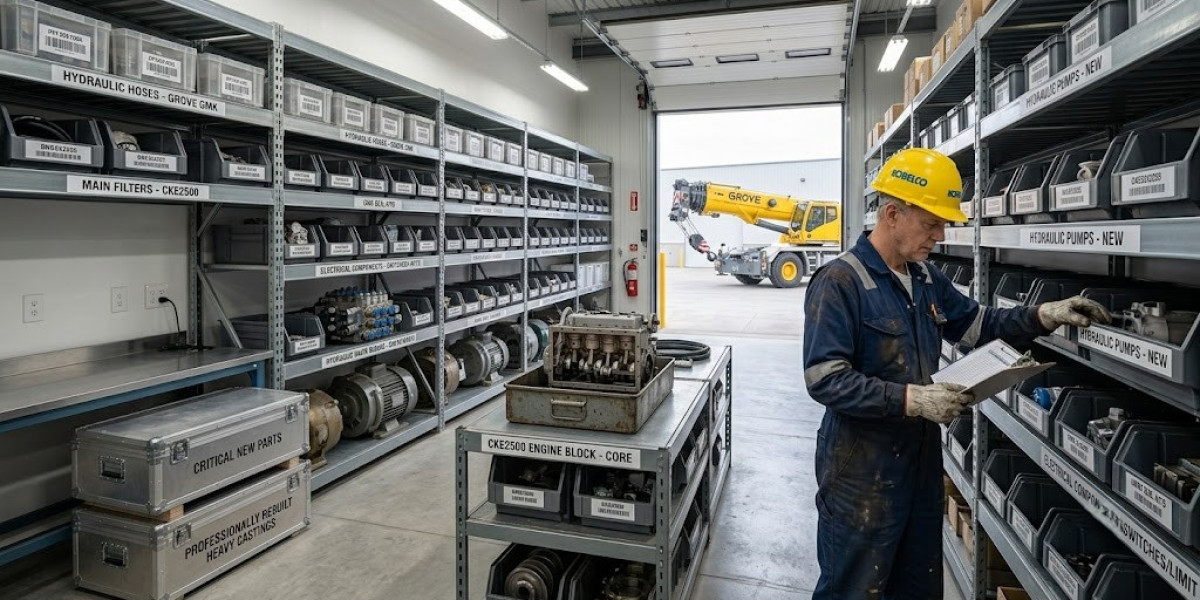
Hydraulic circuits typically absorb the most punishment. Hoses develop fatigue cracks from repeated flexion cycles. O-rings lose their resilience under temperature extremes. Internal cylinder wear accumulates until new seals become necessary. Maintain a rotating supply of the most commonly consumed hose diameters and model-specific seal kits.
Filters offer another category where proactive stocking delivers immediate value. Engine oil, fuel, and hydraulic return filters follow well-documented consumption intervals. Their individual cost is minimal, and purchasing in volume is straightforward economics. Discovering you lack a basic filter during a scheduled service is a frustrating and entirely avoidable setback.
Smaller electrical components also deserve permanent placement in your storeroom. Boom-mounted limit switches regulate travel boundaries by communicating with the onboard computer. Mounted externally, they endure constant exposure to moisture, ultraviolet light, and mechanical vibration. Their operational life is inherently limited, so having several spares accessible in the cab or a nearby tool locker is both prudent and inexpensive.
Start With What the Manufacturer Already Told You
Your operator's manual contains a recommended spares list assembled by the engineers who designed your crane. These recommendations draw on engineering analysis, warranty data, and performance observations gathered across extensive populations of machines worldwide.
Navigate to the preventative maintenance chapter and its associated parts recommendations. Treat this list as your baseline framework. It reflects what the people closest to the machine's engineering believe you're most likely to need during its operational service life.
The crucial refinement comes from filtering those recommendations through your own operational reality. If the manual suggests keeping an extra hydraulic pump as necessary Grove crane parts but yours has never failed across fifteen years, redirect those resources toward higher-probability items. If it recommends surplus boom alignment pins and your crews replace them frequently, stock them liberally. The manufacturer provides the authoritative baseline; your personal experience sharpens it into something precisely calibrated to your conditions.
Read the Story Your Own Maintenance Records Tell
Your fleet's repair history is arguably the most valuable predictive tool you possess. It captures the exact failure patterns your equipment produces under your particular operating conditions, climates, and usage intensities.
Pull work orders from at least the past twenty-four months and organize them by component type and recurrence frequency. Search for repetition that indicates a systemic need. Did one particular relay fail three times during cold-weather operations? Did a specific machine consume track tensioner seals at twice the rate of its sister units?
Apply a clear decision threshold. A single failure might represent an anomaly or unusual circumstance. Two or more failures of the same component within a compressed timeframe constitute a reliable pattern. Elevate those recurring items to your priority stocking list without hesitation.
Fleet age introduces additional nuance that deserves consideration. Older machines consume wiring, sensors, and structural hardware at higher rates than newer units. A recently commissioned crane mostly requires routine consumables. Your shelf composition should mirror the actual wear profile of each machine rather than following a uniform template applied across every unit.
Factor in How Long Different Items Take to Procure
Lead times vary enormously across the range of components your fleet might require, and understanding these differences is essential to making intelligent stocking decisions.
Many common Grove crane parts are held in stock by regional dealers and can be obtained within hours. For those readily accessible items, maintaining an extensive personal reserve may not represent the most efficient allocation of your capital or storage capacity.
Other components present a completely different logistical reality. Specialized control modules, particular boom segments, or parts manufactured overseas can require weeks or months to arrive. When you know a specific item carries a lead time of thirty days or more, keeping a backup already in your possession is a straightforward business decision. No operation can maintain professional credibility by telling a client their project is on hold for a month while an international shipment makes its way through customs.
Establish a routine of verifying current lead times with every supplier. Structure your most critical holdings around whichever items carry the longest procurement cycles. This discipline alone prevents the most devastating and expensive disruptions from ever taking root in your operation.
Prevent Your Stock From Aging Out Silently
An inventory that goes unmonitored will eventually betray your expectations. Stored components degrade regardless of whether anyone handles them. Rubber seals craze and harden. Electrical contacts corrode in humid storage environments. Grease in sealed containers separates over time and loses its protective properties.
Implement a strict First-In, First-Out rotation throughout your storeroom. When fresh deliveries arrive, place them behind the older stock so the oldest units get consumed first. This prevents components from quietly aging past their useful service life.
Every six months, conduct a thorough walkthrough of your parts room. Anything that has been sitting untouched for three years demands honest scrutiny. The machine it was originally purchased for may have been retired, or your operational demands may have shifted. Remove items that no longer serve a realistic purpose rather than letting them silently drain capital and occupy valuable space.
Build a Relationship That Extends Beyond Purchases
Self-sufficiency in parts management is not a realistic goal. The global supply chain for heavy equipment components spans multiple continents and is vulnerable to disruption at countless points along the way.
Your parts distributor fills the gaps that even the most carefully curated stockpile cannot cover. Identify a partner with genuine depth of expertise in Grove crane parts — someone who can discuss your equipment's technical needs with confidence drawn from direct experience.
Share your fleet composition, operating conditions, and maintenance history openly. A well-informed supplier can help you refine your stocking priorities, provide early warning about factory backorders, and suggest practical alternatives when original equipment components face extended unavailability.
Those partnerships reveal their greatest value during emergencies. A critical failure on a Friday afternoon demands a supplier who takes immediate action and secures overnight delivery — not a recorded message suggesting you call back after the weekend.
Ensure Every Crew Member Follows the Same Process
No inventory system functions without disciplined participation from the people who interact with it daily. Every technician on your team needs to understand the room layout, know where specific items are stored, and follow a uniform procedure for documenting what they remove.
The most critical habit is honest, immediate reporting of every retrieval. When the last component leaves its designated bin, someone must record that fact. An empty bin that nobody flags creates a dangerous false impression of readiness, and the next failure involving that part becomes an emergency order with costly consequences.
Simplify the documentation process to minimize resistance. Barcode scanners, sign-out sheets, or lightweight digital tools all accomplish the goal with minimal burden. Pair this with automated reorder thresholds that trigger purchase requests when stock before they develop into crises.
Balance Competing Financial Pressures
At its foundation, every stocking decision requires navigating the dips below predetermined levels, ensuring potential gaps are identified tension between two opposing forces. Carrying costs — storage, insurance, immobilized capital — favor keeping less on hand. Downtime consequences — lost revenue, contractual penalties, reputational harm — favor keeping more.
A mathematically perfect outcome is not achievable. You will store items that never get consumed, and you will periodically encounter an empty shelf at the worst possible moment. Every operation contends with these realities.
What you can accomplish is a consistent reduction in both types of misses. By analyzing your failure patterns, tracking procurement timelines, and concentrating your investment on the components most prone to failure, you build a system where foresight consistently outperforms reaction. Deliberate planning gradually replaces frantic improvisation.
When a hose gives way on a Thursday morning, your technician walks to the parts room, retrieves the correct replacement, and completes the repair before the crew breaks for lunch. That quiet, efficient resolution is the objective — sustained uptime that keeps your equipment productive and your operation financially resilient across every project you undertake.