
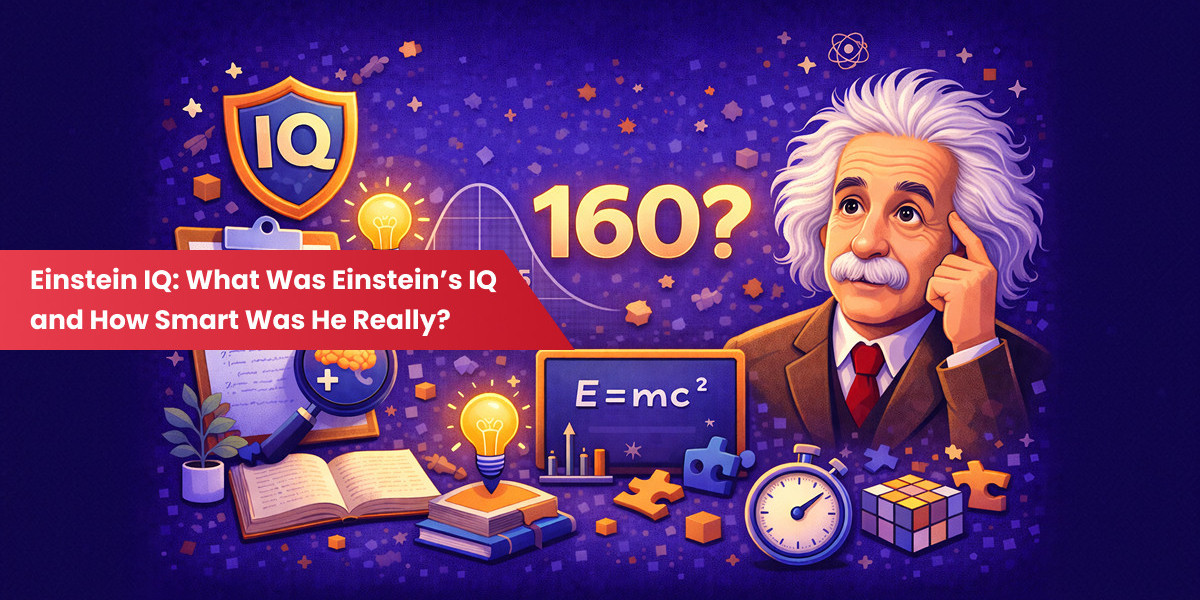
Few names in the history of science are as widely recognized as Albert Einstein. His ideas reshaped modern physics and permanently changed how humanity understands space, time, and the universe. Because of his legendary status, one question continues to attract curiosity: what is Albert Einstein’s IQ?
People often search for a number that can define his intelligence. However, Einstein’s genius cannot be reduced to a single score. While many estimates exist, there is no verified IQ measurement for him. Instead, his intelligence is best understood through his scientific contributions and the revolutionary impact they had on the world.
This article explores Einstein’s IQ, the myths surrounding it, and how his thinking transformed science forever.
Why People Ask About Einstein’s IQ
The fascination with Einstein’s intelligence comes from his extraordinary achievements. He developed theories that challenged centuries of scientific thinking and introduced concepts that still define modern physics.
His most famous work is the Theory of Relativity, which changed how scientists understand time, space, and gravity.
Because his ideas are so advanced, people naturally try to quantify his intelligence. IQ scores provide a simple way to compare cognitive ability, which is why the phrase what is Albert Einstein’s IQ is searched so frequently.
However, intelligence is far more complex than a number.
Did Einstein Ever Take an IQ Test?
One of the most important facts to understand is that Einstein never took a modern IQ test.
IQ testing as we know it today was still developing during his lifetime. While early intelligence assessments existed, they were not standardized in the same way as modern psychological tests.
Because of this, there is no official record of Einstein’s IQ score. Any number associated with him is an estimate based on his achievements rather than actual testing.
Most estimates place Einstein’s IQ between 160 and 190, but these figures are speculative.
What IQ Actually Measures
To understand why Einstein’s IQ cannot be precisely determined, it is important to understand what IQ tests measure.
IQ, or Intelligence Quotient, evaluates specific cognitive abilities such as:
- Logical reasoning
- Mathematical problem solving
- Pattern recognition
- Spatial reasoning
- Verbal comprehension
- Memory and processing speed
Most modern IQ tests are standardized so that the average score is 100. Scores above 130 are considered very high.
However, IQ tests do not measure many qualities that contribute to real world success, including:
- Creativity
- Curiosity
- Emotional intelligence
- Imagination
- Scientific intuition
- Independent thinking
These limitations are especially important when evaluating someone like Einstein.
What Is Albert Einstein’s IQ According to Estimates?
When people ask what is albert einstein’s iq they are usually referring to estimated values rather than confirmed data.
Most commonly cited estimates range from 160 to 190. Some sources suggest even higher numbers, but none of these are scientifically verified.
These estimates are based on:
- His groundbreaking scientific achievements
- His academic performance in mathematics and physics
- His ability to solve complex theoretical problems
- His influence on modern scientific thought
It is important to understand that these are educated guesses, not actual measurements.
Why Einstein Is Considered a Genius
Even without a verified IQ score, Einstein’s intellectual abilities are beyond question.
His work fundamentally changed science and introduced ideas that redefined reality itself.
The Theory of Relativity
Einstein’s most important contribution is the Theory of Relativity. This theory showed that time and space are not fixed but relative to the observer.
It replaced long standing Newtonian ideas and introduced a completely new understanding of gravity.
The Photoelectric Effect
Einstein also explained the photoelectric effect, which demonstrated that light behaves as both a particle and a wave. This discovery helped establish the foundation of quantum physics.
For this work, he received the Nobel Prize in Physics.
These contributions alone place him among the most influential scientists in history.
Myths About Einstein’s Intelligence
Over the years, several myths about Einstein’s intelligence have spread widely.
Myth 1: Einstein Had a Verified IQ Score
There is no evidence that Einstein ever took an IQ test. Any claimed score is purely speculative.
Myth 2: Einstein Was a Poor Student
This myth is false. Einstein was strong in mathematics and physics from a young age and performed well academically in scientific subjects.
Myth 3: IQ Explains Genius
Another misconception is that IQ alone explains Einstein’s genius. In reality, intelligence is multi dimensional and includes creativity, curiosity, and persistence.
The Real Sources of Einstein’s Genius
Einstein’s intelligence went far beyond what IQ tests measure.
Creativity
Einstein had an extraordinary ability to imagine new concepts and mental models. He often visualized complex physical scenarios rather than relying solely on equations.
Curiosity
He constantly questioned how the universe works. His curiosity led him to explore fundamental problems in physics that others had overlooked.
Independent Thinking
Einstein did not accept established scientific ideas without question. He challenged conventional theories and developed new frameworks for understanding reality.
Persistence
Scientific discovery requires long term effort. Einstein continued refining his theories even when they were initially misunderstood or criticized.
How Einstein Changed Science Forever
Einstein’s intelligence had a direct impact on the development of modern science.
His theories influenced:
- Physics
- Astronomy
- Cosmology
- Engineering
- Technology
One of the most practical applications of his work is in modern GPS systems. Without corrections based on relativity, GPS technology would not function accurately.
His ideas continue to influence research in black holes, quantum mechanics, and space exploration.
Comparing Einstein to Other Thinkers
People often compare Einstein with other famous intellectuals such as:
- Isaac Newton
- Nikola Tesla
- Stephen Hawking
- Leonardo da Vinci
These comparisons often include estimated IQ scores, but none of these figures are based on verified testing.
Each thinker contributed differently. Newton developed classical mechanics, Tesla advanced electrical systems, Hawking expanded cosmology, and Leonardo excelled across art and science.
Einstein’s contribution stands out because it fundamentally changed the framework of physics itself.
Why IQ Is Not Enough to Explain Einstein
Even if Einstein had a very high IQ, it would not fully explain his genius.
IQ tests measure limited cognitive skills such as reasoning and pattern recognition. They do not measure:
- Imagination
- Scientific insight
- Creative problem solving
- Deep conceptual thinking
Einstein’s breakthroughs required all of these abilities working together.
What Modern Science Says About Intelligence
Today, psychologists understand intelligence as a combination of multiple abilities rather than a single number.
These include:
- Logical intelligence
- Creative intelligence
- Emotional intelligence
- Social intelligence
- Practical intelligence
Einstein likely excelled in several of these areas, especially creative and logical intelligence.
Why People Still Search “What Is Albert Einstein’s IQ”
The question what is Albert Einstein’s IQ remains popular because people want a simple explanation for genius.
A number feels easier to understand than complex scientific achievements. However, Einstein’s life shows that genius cannot be reduced to a score.
His intelligence was a combination of logic, imagination, curiosity, and persistence.
Final Thoughts
When discussing Albert Einstein IQ, the most important fact is that there is no verified IQ score for him. All commonly cited numbers are estimates rather than scientific measurements.
More importantly, focusing on a number misses the true essence of his genius. Einstein’s intelligence changed science forever through ideas that reshaped our understanding of reality.
His legacy is not defined by a score but by his contributions to human knowledge. He showed that true intelligence is not just about solving problems but about redefining them entirely.
Einstein’s life proves that genius cannot be measured by IQ alone. It is defined by creativity, curiosity, and the courage to think differently, qualities that continue to inspire science and humanity today.






