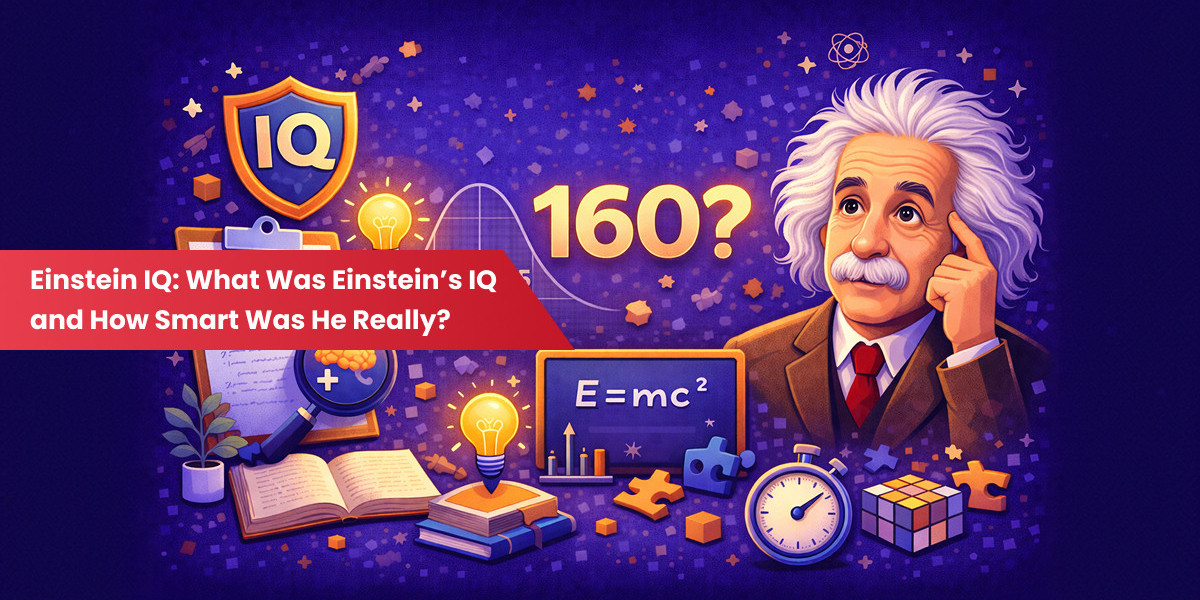
Albert Einstein is one of the most recognized scientists in human history. His name is often used as a symbol of genius, and his theories have reshaped our understanding of the universe. Because of this reputation, people frequently search for information about einstein's iq and try to determine how intelligent he really was. However, much of what people believe about his IQ is based on myths, assumptions, and estimations rather than verified facts.
In reality, Einstein never took a formal IQ test, and there is no official record of his intelligence score. This has not stopped researchers, writers, and enthusiasts from speculating about his cognitive abilities. To truly understand Einstein’s intelligence, it is important to separate myths from facts and explore what we actually know.
Myth 1: Einstein Had an Official IQ Score
One of the most common myths about einstein's iq is that he took an IQ test and received a recorded score. This is not true. Albert Einstein never participated in a standardized IQ test during his lifetime.
IQ testing systems were still developing in the early 20th century, and they were not as widely used or standardized as they are today. Because of this, no official documentation exists that confirms Einstein’s IQ.
Any number you see online claiming to represent his IQ is an estimate, not a verified fact. This is the first and most important misunderstanding to clear up when discussing einstein's iq.
Myth 2: Einstein Struggled Academically
Another widespread myth is that Einstein was a poor student who failed in school. This story is often repeated to make his genius seem more dramatic, but it is misleading.
In reality, Einstein was strong in mathematics and physics from a young age. He showed advanced understanding of mathematical concepts during his teenage years. While he did not always enjoy rigid teaching methods, he was far from academically weak.
The myth likely comes from confusion about grading systems and early reports that were misinterpreted. His academic record shows that he was intellectually capable and highly skilled in scientific subjects.
This myth is often linked to discussions about einstein's iq, but it does not reflect historical evidence.
Myth 3: IQ Fully Explains Einstein’s Genius
Many people assume that if we knew einstein's iq, we would fully understand his genius. This is another misconception.
IQ tests measure certain cognitive abilities such as logical reasoning, memory, and pattern recognition. However, they do not measure creativity, imagination, curiosity, or persistence.
Einstein’s success came from a combination of skills that go far beyond what IQ tests can measure. He was not only logical but also deeply imaginative. He could visualize complex scientific concepts in his mind before proving them mathematically.
This shows that even if we had an exact IQ score, it would not fully explain his intelligence.
Fact 1: Einstein Never Took an IQ Test
The most important fact about einstein's iq is that there is no official IQ score for him. He never took a standardized test, and no record of such a test exists.
This means that all numbers associated with his IQ are speculative. Most estimates range between 160 and 190, but these are based on his achievements rather than test results.
Experts use his scientific contributions, problem-solving ability, and creativity to approximate his intellectual level, but this is not a scientific measurement.
Fact 2: Einstein’s Theories Changed Science Forever
Even without a measurable IQ score, Einstein’s contributions to science are undeniable. His work completely changed how we understand space, time, energy, and gravity.
One of his most famous contributions is the equation:
E = mc^2
This equation shows that mass and energy are interchangeable, forming the foundation of modern physics.
He also developed the theory of general relativity, which redefined gravity as the curvature of spacetime. These discoveries are among the most important scientific achievements in history.
When people ask about einstein's iq, they are often trying to understand how someone could think at such a revolutionary level.
Fact 3: Einstein Used Thought Experiments
One of Einstein’s most remarkable intellectual tools was the use of thought experiments. Instead of relying only on physical experiments, he imagined scenarios in his mind to explore scientific ideas.
For example, he imagined traveling alongside a beam of light to understand how time and space behave at high speeds. This mental exercise contributed to the development of special relativity.
This ability to think abstractly and visually is one reason Einstein is considered a genius. It also shows that intelligence is not limited to solving puzzles or answering test questions.
When discussing einstein's iq, this creative thinking style is often more important than any numerical estimate.
Fact 4: Estimated IQ Range Exists but Is Not Confirmed
Although there is no official score, many psychologists and historians estimate Einstein’s IQ to be between 160 and 190.
To understand this range, it helps to look at IQ classifications:
- Average IQ: around 100
- Above average: 110 to 119
- Gifted: 130 to 145
- Genius level: 160 and above
If these estimates are accurate, Einstein would fall into the genius category. However, it is important to remember that these numbers are not scientifically verified.
They are simply educated guesses based on his intellectual output.
Fact 5: Intelligence Is Multi-Dimensional
Modern psychology shows that intelligence is not a single fixed ability. Instead, it includes multiple types such as:
- Logical intelligence
- Creative intelligence
- Emotional intelligence
- Social intelligence
- Practical intelligence
Einstein excelled particularly in logical and creative thinking. He was able to combine mathematical precision with imagination, which made his work revolutionary.
This is why focusing only on einstein's iq gives an incomplete picture of his abilities.
Why Myths About Einstein Persist
There are several reasons why myths about einstein's iq and his life continue to spread.
First, people are naturally attracted to simple explanations. A single IQ number feels easier to understand than complex scientific thinking.
Second, Einstein’s personality and appearance contributed to his “genius image.” His unusual hair and humble lifestyle made him a cultural icon.
Third, stories about struggling students becoming geniuses are inspiring, even if they are not always accurate.
These factors keep myths alive even when historical evidence says otherwise.
Comparing Einstein With Other Thinkers
People often compare Einstein’s estimated IQ with other historical figures such as Isaac Newton or Nikola Tesla. However, these comparisons are not reliable.
Most of these individuals never took IQ tests, and their scores are also based on speculation. For example:
- Isaac Newton: estimated 190 to 200
- Nikola Tesla: estimated 160 to 310
- Stephen Hawking: around 160
- Albert Einstein: estimated 160 to 190
These numbers should be viewed cautiously because they are not scientifically validated.
Why Einstein Still Fascinates Scientists Today
Even today, scientists study Einstein’s work not because of einstein's iq, but because of his thinking process and scientific insights.
His theories continue to influence modern physics, including astrophysics, cosmology, and quantum research. Technologies such as GPS systems also rely on principles from his relativity theory.
Scientists are fascinated by how he was able to reach such groundbreaking conclusions with limited experimental tools compared to today’s technology.
His ability to think differently is what makes him timeless.
The Real Measure of Einstein’s Intelligence
If we move beyond myths and focus on facts, it becomes clear that Einstein’s intelligence cannot be measured by a single number.
His real genius lay in:
- Deep curiosity
- Powerful imagination
- Ability to question assumptions
- Strong logical reasoning
- Persistence in solving complex problems
These qualities are far more important than any IQ score.
When people ask about einstein's iq, they are really trying to understand what made him extraordinary. The answer lies not in a test score but in his unique way of thinking.
Conclusion
The topic of einstein's iq is surrounded by myths, misunderstandings, and speculation. The most important fact is that Einstein never took an IQ test, and there is no official score.
While estimates suggest a range between 160 and 190, these numbers are not confirmed. More importantly, they do not define his genius.
Einstein’s true intelligence came from his creativity, imagination, and ability to transform abstract ideas into scientific breakthroughs. His work changed the world and continues to influence science today.
In the end, the fascination with einstein's iq reflects our desire to understand genius, but Einstein’s legacy shows that intelligence is far more complex than any number can capture.