
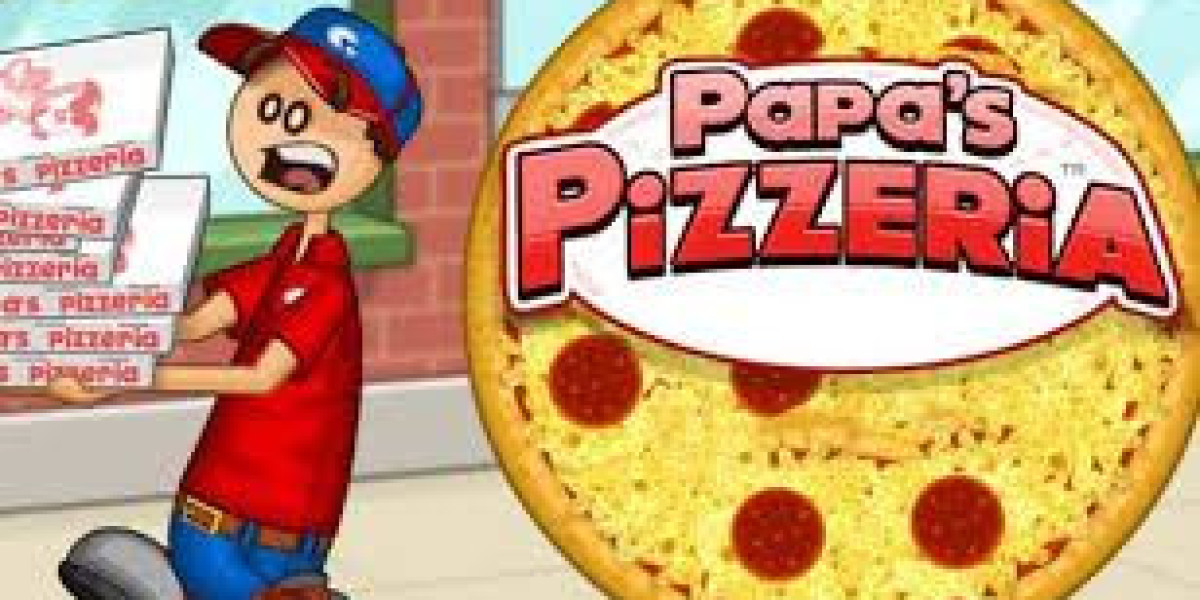
There’s a specific kind of focus that appears when a screen is asking you to do five things at once, but never explicitly tells you to panic. Games like Papa's Pizzeria sit in that strange space where you’re constantly busy, yet rarely overwhelmed in the way real stress feels.
You take an order, stretch dough, layer toppings, watch an oven timer, slice carefully, and serve—all in a loop that looks simple until it starts overlapping. What’s interesting isn’t the pizza itself, but how quickly your mind adapts to juggling it.
It feels like play. But it also feels like training.
The rhythm hidden inside repetition
At the beginning, everything feels manual. You read the order ticket carefully, double-check ingredients, and move between stations with deliberate attention. Nothing is automatic yet.
Then something shifts.
After a few rounds, your brain starts predicting steps before they appear. You begin placing pepperoni while already thinking about the next customer. The oven timer stops feeling like a warning and starts feeling like background rhythm.
That’s where the loop changes.
What used to be separate actions becomes a continuous flow. Instead of “do this, then that,” it becomes “keep everything moving.” The structure doesn’t change, but your relationship to it does.
This is the quiet trick behind many cooking and time-management games: they don’t teach complexity—they teach flow.
The pressure that never fully becomes panic
There’s always something slightly unfinished. A pizza waiting to be topped. Another baking a few seconds too long. A customer patiently sitting in the corner, slowly losing satisfaction.
But the pressure never fully tips into chaos. It hovers just below it.
That balance is important. If it were too relaxed, it would be boring. If it were too strict, it would become exhausting. Instead, it sits in a narrow band where you always feel “almost fine.”
This creates a strange mental state where urgency exists without fear. You move faster, but not because you’re stressed in a traditional sense. You move faster because the system gently rewards it.
Even mistakes are soft. A slightly overcooked pizza doesn’t end the session. A messy slice doesn’t break the game. It just nudges you to pay attention next time.
That softness is what makes the pressure sustainable.
How multitasking becomes instinct
One of the most interesting parts of these games is how quickly multitasking stops feeling like multitasking.
At first, you consciously track everything: oven time, topping order, incoming customers. It feels like managing separate threads.
Then something changes.
You stop “thinking” about tasks individually and start feeling their timing. You glance at the oven without fully deciding to. You begin topping pizzas while half-aware of another order waiting. Attention becomes distributed instead of sequential.
It’s not that you’re doing more. It’s that your brain compresses the steps into patterns.
That’s why players often get faster without realizing exactly how they improved. It’s not a single skill being learned—it’s a system of timing being internalized.
There’s a subtle shift from reaction to anticipation.
The small satisfaction of precision
Even when everything is hectic, there’s still a strange satisfaction in doing things cleanly.
Perfect topping placement. A pizza removed from the oven at just the right moment. A clean cut that matches the order exactly.
None of these moments are dramatic. But they register.
They feel good in a quiet way, like tidying a small space you didn’t realize was bothering you.
That’s part of the appeal: the game constantly offers micro-rewards for attention. Not big achievements, just small confirmations that you were precise enough.
Over time, players often start caring about details they previously ignored. Not because the game demands perfection, but because improvement becomes visible in tiny increments.
That feedback loop is powerful. It doesn’t need narrative or reward systems layered on top. The task itself becomes the reward structure.
When repetition becomes comfort instead of boredom
Repetition is usually treated as something to avoid in games. But here, repetition is the point.
The same steps happen over and over, but never in exactly the same combination. Different orders create different pressures. Timing shifts constantly. No two cycles feel identical, even if the actions are familiar.
That’s where comfort appears.
The structure stays stable, so your mind doesn’t need to relearn anything. But the variations keep it from becoming mechanical. It sits in a middle space between predictability and surprise.
This is also where players often develop personal rhythm. Some prefer clearing toppings first. Others focus on oven timing above all else. A few treat the game almost like choreography, following a strict internal sequence every round.
None of these approaches are required. But the system allows them, which makes players feel like they’ve discovered their own method rather than following a script.
That sense of ownership, even in a simple loop, is what makes repetition feel meaningful instead of dull.
The browser-game memory effect
For many players, these games are tied less to mastery and more to memory. They belong to a specific era of quick-access browser games—instant loading, minimal instructions, no long-term commitment.
You didn’t need to “get into” them. You just played.
That immediacy shaped how they were experienced. Sessions were short, often spontaneous, and rarely planned. You’d open a tab, play a few rounds, close it, and move on.
But the structure stuck anyway.
Even now, people can remember the rhythm of order tickets, oven timers, and topping stations without needing to re-learn anything. That’s because the mechanics were simple enough to encode quickly, but structured enough to remain recognizable.
There’s a nostalgia there, but it’s not just about the game itself. It’s about a way of interacting with games that felt lighter, more temporary, and less demanding of attention.
Why the loop still holds up today
Even in a landscape filled with complex systems and high-fidelity experiences, this kind of gameplay still works because it focuses on something very basic: controlled attention under mild pressure.
There’s no deep story pulling you forward. No sprawling progression system demanding long-term investment. Just a repeating cycle of tasks that gradually become second nature.
And somehow, that’s enough.
The satisfaction comes from clarity. You always know what needs to be done. You just have to manage how quickly and accurately you can do it.
That clarity is rare in more complex games, where systems can sometimes obscure rather than simplify. Here, everything is visible. Nothing is hidden behind layers of mechanics.
What you see is what you manage.
A loop that lingers longer than expected
Even after stepping away, it’s easy to mentally replay the structure. Order, dough, toppings, oven, slice, serve. The sequence stays intact, almost like a rhythm you can recall without trying.
That persistence is probably the most interesting part.
Not that the game is difficult or deep in the traditional sense, but that it creates a pattern your mind quietly retains. A small loop of attention, timing, and repetition that stays with you longer than expected.
And maybe that’s the real reason it sticks. It doesn’t ask for memory in the narrative sense—it builds memory through motion.






