
INTRODUCTION
A Modular Ophthalmic OT Turnkey Project Company supports a controlled and hygienic surgical environment by integrating modular construction, HVAC systems, HEPA filtration, controlled airflow, pressure management, hygienic surfaces, medical gases, electrical infrastructure, testing, and commissioning. Ophthalmic surgeries require careful environmental control because the operation theatre must support precise procedures while minimizing avoidable sources of airborne and surface contamination. A professionally engineered modular OT brings these components together as one coordinated system rather than treating the room, ventilation, utilities, and finishes as separate installations.
It is important to distinguish between a controlled surgical environment and guaranteed sterility. OT infrastructure can support infection-prevention and contamination-control objectives, but sterility also depends on validated clinical processes, sterilization practices, cleaning, staff behavior, equipment handling, and hospital infection-control procedures.
Why Environmental Control Matters in an Ophthalmic OT
An ophthalmic operation theatre is a specialized clinical environment where surgical precision and infection prevention are important.
During surgery, potential contamination sources can include:
- Personnel movement
- Airborne particles
- Skin scales and microorganisms
- Surgical equipment
- Materials brought into the theatre
- Door opening and closing
- Inadequate airflow
- Poor cleaning practices
- Improper pressure relationships
The National Centre for Disease Control (NCDC) states that airborne bacteria in OTs originate primarily from people and that appropriately circulated clean filtered air can help remove airborne organisms. Its guidance also describes the use of positive pressure and HEPA filtration in OT ventilation.
A turnkey approach coordinates these environmental factors during design, construction, installation, testing, and handover.
Modular Construction for Controlled Environments
Modular construction is an important part of ophthalmic OT engineering.
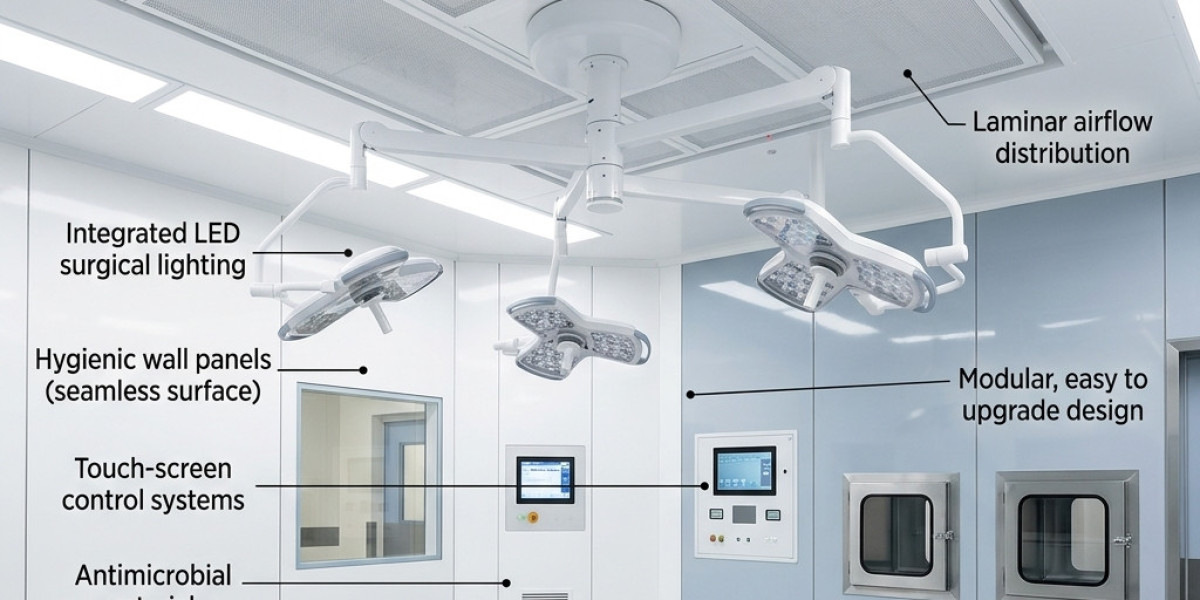
Instead of relying on conventional exposed construction surfaces, modular OT systems can incorporate purpose-designed wall and ceiling panels that create a more controlled internal environment.
Typical considerations include:
- Smooth wall surfaces
- Sealed panel joints
- Hygienic ceiling systems
- Flush installations
- Easy-to-clean surfaces
- Reduced dust-retaining areas
- Properly sealed service penetrations
- Hygienic corners and coving
NCDC guidance recommends OT surfaces that are hard, non-porous, and smooth because such surfaces are easier to maintain in a healthcare environment.
The exact materials should be selected according to the hospital's specifications, cleaning procedures, durability requirements, and applicable standards.
HEPA Filtration for Airborne Particle Control
HEPA filtration is one of the central components of controlled OT ventilation.
HEPA filters can remove very small airborne particles from supplied air and are commonly integrated into ventilation systems serving contamination-sensitive areas.
NCDC guidance specifically recommends circulating OT air under positive pressure through HEPA filters and states that HEPA filters should be monitored regularly and changed when required.
A properly designed system considers:
- HEPA filter efficiency
- Filter quantity
- Filter size
- Filter housing
- Sealing
- Airflow volume
- Pressure drop
- Fan capacity
- Accessibility for maintenance
HEPA filtration is not an independent guarantee of sterility. It works as one part of the broader environmental-control system.
Laminar and Controlled Airflow
Controlled or unidirectional airflow can help manage airborne particles around critical surgical areas.
A turnkey ophthalmic OT project may integrate airflow systems with:
- HEPA filtration
- Supply-air terminals
- HVAC equipment
- Return-air pathways
- Pressure controls
- Airflow monitoring
The airflow design should consider the position of the operating table, surgical microscope, lights, medical equipment, personnel, and other potential obstructions.
Poorly positioned equipment can disturb airflow and create unwanted turbulence. Therefore, airflow engineering and equipment planning should be performed together.
HVAC System Integration
HVAC engineering is fundamental to maintaining controlled environmental conditions.
A specialized project should consider:
- Temperature
- Relative humidity
- Fresh-air requirements
- Air changes
- Air distribution
- Pressure relationships
- Filtration
- Cooling capacity
- Heat loads
- Exhaust requirements
- Monitoring and controls
NCDC guidance identifies 20 air changes per hour as the recommended ventilation rate for an OT and specifies a temperature range of 18–24°C in its ventilation and design guidance. These figures should be interpreted within the applicable healthcare requirements and project specifications rather than treated as universal values for every facility.
Proper HVAC engineering helps maintain predictable conditions while supporting the airflow strategy.
Positive Pressure Management
Pressure relationships are another important part of contamination control.
In a controlled OT environment, positive pressure can help limit the movement of less-clean air into cleaner areas when doors or other openings are present.
The turnkey engineering process should therefore assess:
- OT pressure
- Adjacent room pressure
- Air supply volume
- Exhaust volume
- Door operation
- Room leakage
- Airflow direction
NCDC recommends directing airflow from cleaner or aseptic zones toward less-clean areas using appropriate pressure gradients.
Pressure management should be designed together with the complete HVAC system rather than added after construction.
Hygienic Flooring and Wall Finishes
The internal finishes of an ophthalmic OT can influence cleaning and maintenance.
Suitable finishes should generally support:
- Easy cleaning
- Resistance to routine disinfectants
- Minimal particle retention
- Smooth surfaces
- Durable performance
- Sealed joints
- Reduced microbial harborage opportunities
Common project materials may include hygienic modular wall panels, epoxy flooring, resilient sheet flooring, stainless-steel components, and sealed ceiling systems, depending on the design specification.
Floor-to-wall junctions should be detailed carefully to minimize difficult-to-clean gaps.
Sealed Doors and Controlled Access
Doors are an important part of maintaining environmental control.
An ophthalmic OT may use appropriately designed sealed or hermetic doors depending on the project requirements.
Door planning can address:
- Controlled access
- Reduced air leakage
- Easy cleaning
- Smooth surfaces
- Proper sealing
- Workflow separation
- Pressure stability
Access control can also reduce unnecessary movement into the operating theatre.
NCDC's OT zoning guidance separates areas according to cleanliness and access requirements, with the OT positioned in the cleanest or aseptic zone.
Zoning and Personnel Movement
Even advanced ventilation systems can be affected by excessive personnel movement.
A well-planned turnkey OT should therefore consider the movement of:
- Surgeons
- Nurses
- Anesthesia personnel
- Technicians
- Patients
- Equipment
- Sterile supplies
- Waste
Clean and less-clean workflows should be separated as far as practical.
Restricted access and organized movement can help reduce unnecessary door opening and airborne disturbance.
Ophthalmic Equipment Integration
Ophthalmic surgery requires specialized equipment, including operating microscopes, surgical tables, phacoemulsification systems, surgical lights, monitors, and other supporting devices.
Equipment planning should be coordinated with the environmental system.
The design team should evaluate:
- Equipment dimensions
- Heat generation
- Electrical loads
- Positioning
- Ceiling services
- Airflow obstruction
- Operator ergonomics
- Maintenance access
- Data connections
The recently published ISO 14644-14:2026 provides a methodology for assessing equipment suitability for cleanrooms and controlled environments with respect to airborne particle cleanliness. It does not itself establish that every piece of hospital equipment must be assessed under the standard, but it demonstrates the importance of considering equipment interaction with controlled environments.
Medical Gas and Electrical Infrastructure
Environmental control also depends on reliable utilities.
A turnkey ophthalmic OT can coordinate:
- Oxygen
- Medical air
- Vacuum
- Electrical outlets
- Emergency power
- Lighting
- Data connections
- Equipment power
- Earthing
- Safety systems
Utility outlets should be positioned to support the clinical workflow without interfering with cleaning or airflow.
Electrical and medical-gas infrastructure should also be accessible for maintenance while maintaining appropriate sealing and hygiene around service penetrations.
Environmental Monitoring
Environmental monitoring provides information about whether the OT remains within its specified operating conditions.
Depending on the project, monitoring can include:
- Temperature
- Humidity
- Differential pressure
- Airflow
- Particle concentration
- Filter pressure drop
- HVAC alarms
Monitoring systems can provide local displays or integrate with building-management systems where appropriate.
The purpose is not simply to collect data but to identify deviations that may require investigation or corrective action.
Testing and Validation
Testing is essential after installation.
A professional turnkey project should establish a documented commissioning and verification process.
Testing may include:
- HEPA filter integrity testing
- Airflow velocity measurement
- Airflow pattern assessment
- Particle counting
- Pressure differential testing
- Temperature and humidity measurement
- HVAC performance testing
- Electrical testing
- Medical-gas testing
ISO 14644-3:2019 provides cleanroom test methods for both unidirectional and non-unidirectional airflow environments and covers different occupancy states, including as-built, at-rest, and operational conditions.
ISO 14644-1:2015 provides a framework for classifying cleanroom air cleanliness based on airborne particle concentration. It remains the current edition following its 2021 review.
Testing should be matched to the healthcare application and project specifications.
Construction-Phase Contamination Control
The final OT environment can be affected by the way construction and installation are performed.
During project execution, a turnkey team should control:
- Construction dust
- Debris
- Material storage
- Temporary openings
- HVAC contamination
- Panel damage
- Service penetrations
- Final cleaning
The ventilation system and sensitive components should be protected from construction contamination.
Before handover, the theatre should undergo appropriate cleaning, inspection, testing, and commissioning.
Cleaning and Maintenance Support
Environmental performance must be maintained after project completion.
A preventive maintenance program may include:
- HEPA filter inspection
- Filter integrity testing where required
- Airflow verification
- HVAC servicing
- Sensor checks
- Pressure monitoring
- Cleaning
- Door and seal inspection
- Control-system checks
- Documentation
The replacement of filters should be based on applicable procedures, test results, pressure drop, operating conditions, and manufacturer recommendations rather than an arbitrary schedule.
Documentation and Handover
A turnkey project should provide sufficient documentation for hospital teams to operate and maintain the facility.
Documentation may include:
- Approved layouts
- HVAC drawings
- Equipment schedules
- Electrical drawings
- Medical-gas layouts
- Filter specifications
- Test reports
- Commissioning records
- Operation manuals
- Maintenance recommendations
- Warranty information
Complete documentation makes future troubleshooting and maintenance more efficient.
Role of Turnkey Project Execution
One of the major advantages of turnkey execution is coordination.
Instead of separately managing the modular walls, HVAC contractor, electrical contractor, medical-gas contractor, filtration supplier, and testing agency, the hospital can work with one coordinated project partner.
A turnkey approach can help coordinate:
- Site assessment
- Concept design
- Detailed engineering
- Material selection
- Procurement
- Modular construction
- HVAC installation
- Utility integration
- Equipment coordination
- Testing
- Commissioning
- Documentation
- Handover
This integrated approach reduces the possibility of conflicts between individual systems.
Benefits of a Controlled Ophthalmic OT Environment
A professionally engineered modular ophthalmic OT can support:
- Better airborne contamination control
- Controlled temperature and humidity
- Predictable airflow
- Positive pressure management
- Hygienic surfaces
- Efficient surgical workflow
- Easier cleaning
- Organized equipment placement
- Reliable utilities
- Documented performance
- Long-term maintainability
The actual outcome depends on design quality, installation, clinical practices, maintenance, and compliance with applicable requirements.
Conclusion
A Modular Ophthalmic OT Turnkey Project Company supports controlled surgical environments by combining modular construction, HVAC engineering, HEPA filtration, controlled airflow, pressure management, hygienic finishes, utility integration, monitoring, testing, and commissioning into one coordinated project. These systems help hospitals establish an environment designed to support infection-prevention and contamination-control objectives, while clinical sterilization, cleaning, and staff practices remain essential. By integrating design, installation, validation, documentation, and maintenance planning, Altus Airflow helps healthcare institutions develop reliable and future-ready ophthalmic operation theatres tailored to their operational requirements.
Frequently Asked Questions
1. How does a Modular Ophthalmic OT Turnkey Project Company support a controlled surgical environment?
A Modular Ophthalmic OT Turnkey Project Company integrates modular construction, HVAC, HEPA filtration, controlled airflow, pressure management, hygienic finishes, monitoring, testing, and commissioning to support a controlled ophthalmic surgical environment.
2. Does a Modular Ophthalmic OT Turnkey Project Company guarantee sterility?
No. A Modular Ophthalmic OT Turnkey Project Company provides infrastructure that supports contamination control and infection-prevention objectives, but sterility also depends on sterilization, cleaning, clinical protocols, personnel practices, and equipment handling.
3. Why is HEPA filtration important in an ophthalmic OT?
A Modular Ophthalmic OT Turnkey Project Company can integrate HEPA filtration into the HVAC system to reduce airborne particulate contamination and support the delivery of filtered air to the operating theatre.
4. How does positive pressure help an ophthalmic OT?
A Modular Ophthalmic OT Turnkey Project Company can engineer suitable positive pressure relationships so that air generally moves from cleaner areas toward less-clean adjacent areas, helping reduce unwanted infiltration.
5. What role does laminar airflow play in ophthalmic OT design?
A Modular Ophthalmic OT Turnkey Project Company may incorporate unidirectional or laminar airflow where appropriate to help control airborne particles around critical surgical areas, subject to the clinical application and project specifications.
Read Our Previous Blog------>What role does HEPA filtration play in Laminar Airflow System Engineering Company?






