
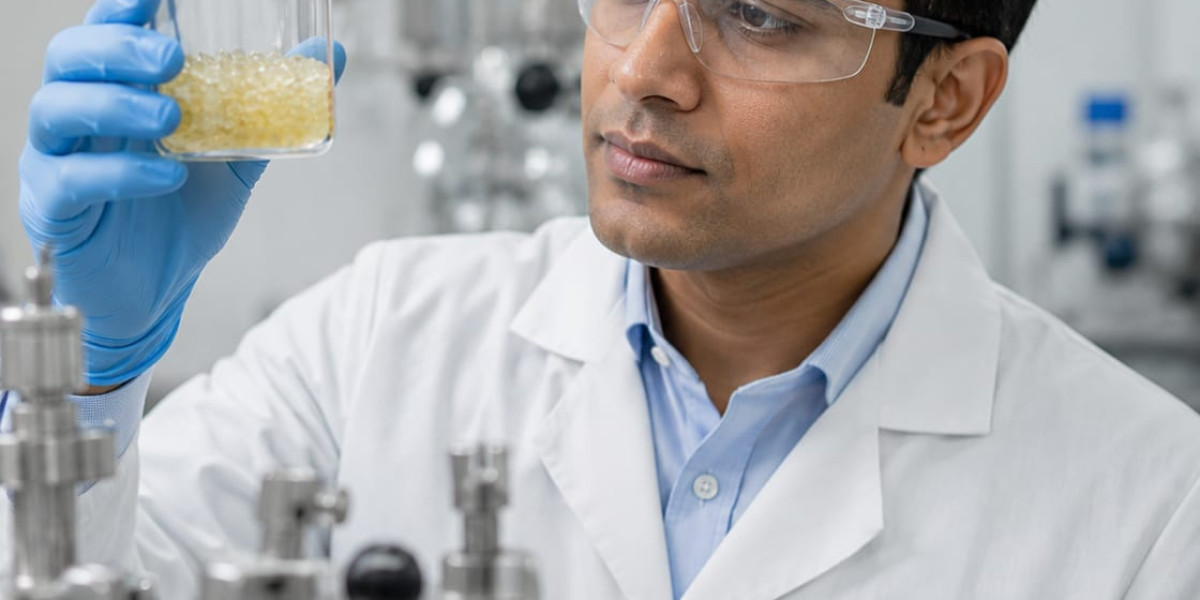
Water softener resin is the essential material inside an ion exchange water softener. These small resin beads remove hardness minerals, primarily calcium and magnesium, from water. By reducing hardness, resin helps control scale and supports better performance of plumbing systems, water heaters, and appliances.
What Is Water Softener Resin?
Water softener resin is a synthetic polymer material manufactured as small spherical beads. Most conventional water softeners use strong acid cation (SAC) resin.
The beads contain negatively charged exchange sites that attract positively charged ions. When the resin is in its sodium form, it holds sodium ions. As hard water passes through the resin, calcium and magnesium ions attach to the resin and sodium ions are released into the treated water.
This process is called ion exchange.
How Does Water Softener Resin Work?
A water softener contains a tank filled with resin beads. During normal operation, hard water flows through the resin bed.
The resin captures calcium and magnesium while releasing sodium. As a result, the water leaving the tank has lower hardness.
The resin has a limited exchange capacity. After treating a certain amount of hard water, the available exchange sites become occupied by hardness minerals. The resin must then be regenerated.
How Is Softener Resin Regenerated?
Regeneration restores the resin so it can continue removing hardness.
In a conventional salt-based system, a concentrated salt solution, known as brine, flows through the resin bed. Sodium ions displace the calcium and magnesium accumulated on the resin.
A typical regeneration cycle includes:
- Backwash – Cleans and expands the resin bed.
- Brine injection – Sends salt solution through the resin.
- Slow rinse – Moves the brine through the bed.
- Fast rinse – Flushes remaining salt and hardness.
- Service – Returns the system to normal operation.
Correct regeneration is important for maintaining resin capacity and consistent softening.
Benefits of Water Softener Resin
A properly selected resin can provide several benefits:
- Reduces calcium and magnesium hardness
- Helps prevent scale buildup
- Protects plumbing and water-using equipment
- Improves soap and detergent performance
- Supports efficient water heating
- Provides consistent hardness reduction
In industrial facilities, softening can also be used as part of a larger water treatment process.
What Affects Resin Performance?
Several factors can influence the performance and lifespan of softener resin:
- Feed-water hardness
- Iron and manganese
- Chlorine and other oxidants
- Organic contaminants
- Water temperature
- Flow rate
- Regeneration conditions
- Resin bed depth
- System maintenance
Testing the incoming water is therefore an important step when selecting resin for a new system.
How to Choose Water Softener Resin
Choosing the right resin depends on the application and operating conditions.
Resin Type
Strong acid cation resin is commonly used for conventional water softening. Different grades may have different capacity, physical stability, and chemical resistance characteristics.
Exchange Capacity
Resin capacity indicates how much hardness can be removed under specified operating conditions. System designers should consider both required capacity and regeneration efficiency.
Bead Size
Resin bead size can influence flow distribution, pressure drop, and treatment performance. The appropriate specification depends on the system design.
Water Quality
Feed-water analysis should consider hardness as well as iron, manganese, chlorine, and other substances that may affect resin performance.
Water Softener Resin for Commercial and Industrial Applications
Water softener resin is used beyond residential water softeners. Commercial and industrial systems may use ion exchange softening for:
- Boiler feedwater pretreatment
- Reverse osmosis pretreatment
- Industrial process water
- Cooling water treatment
- General water conditioning
Industrial systems often require more precise resin selection because flow rates, water chemistry, regeneration requirements, and treatment targets can vary considerably.
How Long Does Water Softener Resin Last?
There is no single replacement interval for every softener. Resin lifespan depends on water chemistry, operating conditions, regeneration practices, and maintenance.
If a softener begins producing hard water, resin replacement is not always the first solution. Check the control valve, brine system, regeneration settings, salt supply, and feed-water conditions first.
If these components are functioning correctly and the resin still has insufficient capacity, replacement may be necessary.
Signs Your Resin May Need Replacement
Potential warning signs include:
- Hardness remains high after regeneration
- Softening capacity has decreased
- The system regenerates more frequently
- Resin beads are damaged or degraded
- Proper cleaning does not restore performance
Professional testing can help determine whether the problem is caused by the resin or another part of the softening system.
Conclusion
Water softener resin is the core component responsible for removing calcium and magnesium through ion exchange. Strong acid cation resin is widely used in conventional softening systems because it can be regenerated and reused.
For the best results, resin should be selected according to feed-water chemistry, flow rate, required capacity, regeneration conditions, and application requirements. Proper system sizing, regeneration, and maintenance can help maintain reliable softening performance and extend resin service life.






