
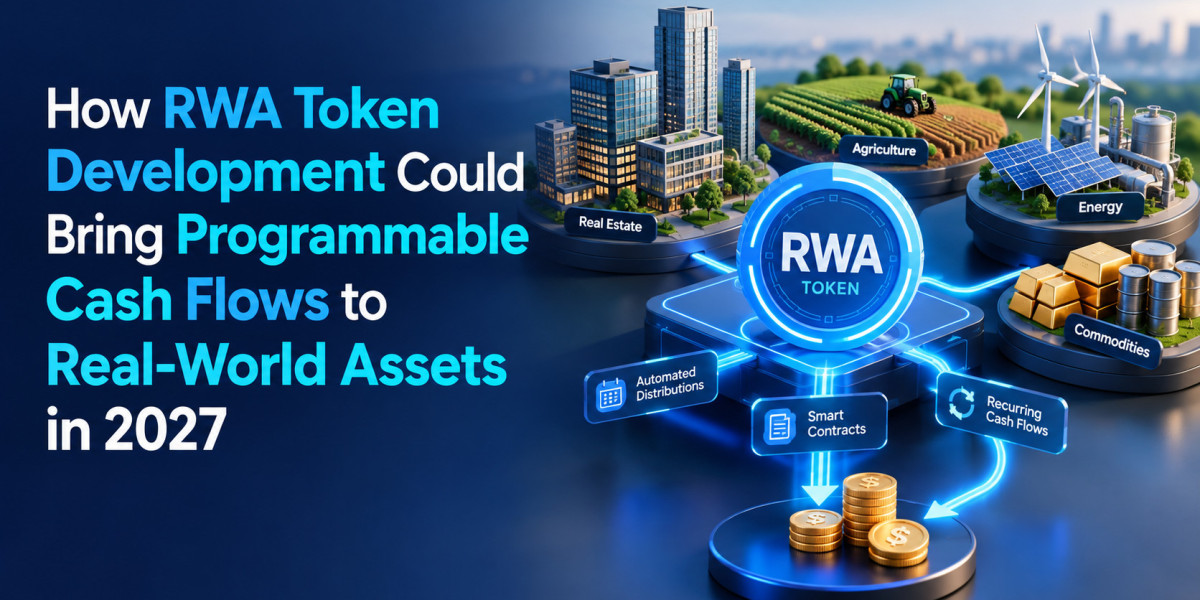
Real-world assets are increasingly being represented in digital form through blockchain-based systems. Property, private credit, commodities, invoices, funds, equipment, and other assets can be connected with digital tokens that represent ownership, economic rights, or claims on future income. As this market develops, the conversation is moving beyond simply creating tokens. One area receiving greater attention is the use of programmable cash flows.
Programmable cash flows refer to financial movements that can follow predefined rules. A smart contract could distribute rental income to eligible token holders, release payments after certain conditions are met, divide revenue between participants, or route repayments according to an agreed schedule. In 2027, RWA token development could make these functions more common across asset-backed financial products.
What Are Programmable Cash Flows in RWA Tokenization?
Traditional asset income often passes through several administrative layers. A property generates rent, for example, and that rent may move through a property manager, bank account, fund administrator, and other parties before investors receive their share. Each stage can involve calculations, records, approvals, and reconciliation.
With RWA tokenization, some of these rules can be represented through smart contracts. The token itself does not automatically make an asset's cash flow programmable. Instead, the surrounding blockchain system can connect token ownership with payment rules, eligibility requirements, distribution schedules, and other conditions.
Suppose a commercial property generates monthly rental income. A tokenized structure could record investor holdings and use predefined rules to calculate each investor's share. Once the required rental amount reaches the relevant payment account or blockchain-based settlement system, the distribution process could follow those rules.
This does not remove the need for banks, administrators, legal entities, property managers, or compliance teams. Rather, it can provide another layer for recording and executing financial instructions.
Why 2027 Could Be Important for Programmable Asset Income
The RWA market is moving toward financial products where ownership records and asset-related information can interact with blockchain infrastructure. As tokenized assets become more sophisticated, investors and institutions may look for functions beyond basic ownership representation.
Programmable cash flows could become relevant because many real-world assets produce recurring income. Bonds generate interest, properties generate rent, private credit produces repayments, funds receive distributions, and invoices generate receivables.
RWA token development could connect these recurring events with digital ownership records. Instead of treating a token as a static representation, platforms could associate it with a set of financial rules.
For example, a tokenized private credit product might have monthly repayment conditions. When a repayment is recorded, the system could calculate how much belongs to each eligible token holder. A tokenized property fund could follow a similar process for rental distributions.
The exact implementation will depend on the asset, jurisdiction, legal structure, custody arrangements, and payment infrastructure.
How Smart Contracts Could Manage Cash Flow Rules
Smart contracts are central to the idea of programmable cash flows. They can contain instructions that determine what happens when specific conditions are satisfied.
For an RWA product, these instructions could cover distribution percentages, payment dates, investor eligibility, reserve requirements, repayment priorities, and other financial conditions.
Consider a tokenized debt instrument with monthly interest payments. A smart contract could reference the token balances of eligible holders and calculate their respective portions when a payment event occurs.
Another structure could use different classes of tokens. Senior investors might receive payments before junior participants, according to the legal terms of the product. The software could represent this payment sequence through predefined rules.
However, smart contracts cannot independently know whether an off-chain event has happened. If a property has received rent in a bank account, for instance, external information may need to reach the blockchain system before a distribution rule can be executed.
This is where oracles, payment providers, custodians, administrators, and other external systems can become important.
Tokenized Real Estate and Recurring Rental Income
Real estate is one of the clearest examples of how programmable cash flows could be used.
A tokenized property can represent ownership interests or economic claims connected to a legal entity holding the property. If that property generates rental income, the platform could connect rental records with investor distributions.
A monthly process might involve collecting rent, deducting permitted expenses, calculating the distributable amount, verifying investor eligibility, and allocating the remaining income according to token holdings.
RWA tokenization could make the ownership ledger easier to coordinate with these calculations. Investors could have a digital record of their holdings while the financial administration continues to operate through the appropriate legal and banking arrangements.
Future systems could also account for different investor classes, lock-up periods, withholding requirements, reserve accounts, and other conditions.
For businesses considering an RWA tokenization development project, the challenge is therefore not only token issuance. The wider system needs to account for how money enters the structure, how it is recorded, and how distributions are handled.
Private Credit Could Use Programmable Repayments
Private credit is another area where programmable cash flows could have practical applications.
A loan produces scheduled financial obligations. Principal, interest, fees, and other payments may follow a predefined timetable. When a credit instrument is represented through tokens, payment events can potentially be associated with token ownership.
An RWA token development project for private credit could include repayment schedules in its financial logic. When an approved payment is received, the system could calculate allocations for the relevant participants.
For example, if a pool contains loans with different repayment dates, the platform could maintain separate records for each instrument. Cash received from borrowers could then be allocated according to the rules associated with each token class.
This approach could be useful for investment funds and financial institutions that need detailed records of asset-level income.
At the same time, default situations require special attention. A smart contract cannot decide the legal outcome of a borrower default unless the applicable rules have been properly defined and connected to appropriate external processes.
Tokenized Funds and Automated Distributions
Funds may also benefit from programmable distribution models.
A tokenized fund can represent interests in a portfolio containing property, credit instruments, commodities, or other assets. Investors may receive periodic distributions based on the fund's income and its governing documents.
RWA tokenization platform development could incorporate investor records, distribution calculations, transfer restrictions, and payment instructions within one system.
For example, an investment fund could establish a quarterly distribution process. The system could identify eligible token holders on a specified record date, calculate each holder's entitlement, and initiate the required payment process.
This does not mean that every step should happen directly on-chain. A hybrid model may be more practical when traditional financial infrastructure remains part of the payment process.
Conditional Payments Could Become More Common
Programmable cash flows are not limited to fixed monthly distributions.
A payment could depend on a particular event. For example, a revenue-sharing agreement might distribute funds only after a specified revenue threshold is reached. A construction-related financing product could release funds after approved project milestones. A trade finance product could initiate payment after required documentation is verified.
These conditions could be represented within the software supporting an RWA tokenization structure.
The benefit comes from having financial rules represented in a form that software can process consistently. Yet those rules must first be legally and commercially defined. The technology should reflect the financial agreement rather than replace it.
Identity and Compliance in Cash Flow Distribution
Programmable payments also require careful attention to investor identity.
Not every token holder may be entitled to receive every distribution. Restrictions can depend on jurisdiction, investor category, holding period, product type, or regulatory requirements.
An RWA tokenization company working on institutional products may therefore need identity verification, wallet screening, transfer restrictions, investor records, and transaction monitoring as part of the platform.
A smart contract can check certain digital conditions, but it depends on reliable information. Off-chain compliance systems may provide the data required before a payment is processed.
This creates a relationship between identity, token ownership, compliance status, and cash flow management. In 2027, this connection could become an important part of institutional RWA infrastructure.
Oracles Could Connect Real-World Events With Blockchain Rules
Real-world assets generate events outside blockchain networks. Rental payments happen through banking systems. Commodity prices come from markets. Loan repayments occur through financial institutions. Property valuations may come from professional valuation providers.
Blockchain applications need a way to receive relevant information from these external environments.
Oracles can provide data that smart contracts use when applying predefined rules. For example, an asset-backed lending system could use an approved valuation source to monitor collateral levels.
However, oracle design needs careful consideration. Data accuracy, update frequency, source selection, fallback mechanisms, and governance can affect how the system behaves.
For an RWA tokenization platform development company, this means the data architecture can be just as important as the token contract itself.
Secondary Markets Could Add Another Layer
Programmable cash flows could also affect how tokenized assets interact with secondary markets.
If a token represents an interest in an income-producing asset, its transfer history may affect future distributions. A platform could need to determine who is eligible for a particular payment based on a record date.
This introduces additional questions around settlement, ownership snapshots, transfer restrictions, and payment timing.
For example, if a token changes hands shortly before a rental distribution date, the legal agreement needs to specify whether the buyer or seller receives that distribution. The platform can then apply the relevant rule.
This illustrates why RWA tokenization development involves more than issuing a digital asset. Ownership, cash flow, legal rights, and settlement processes need to work together.
What an RWA Platform May Need in 2027
A platform supporting programmable asset cash flows could contain several connected components. These may include token contracts, investor onboarding, wallet management, compliance checks, asset records, payment processing, distribution logic, reporting tools, oracle connections, and administrative controls.
The precise feature set will depend on the asset category.
A tokenized property platform may require rental and expense records. A credit platform may require loan schedules and repayment tracking. A tokenized fund may require NAV calculations and investor distribution records.
An RWA tokenization development company may therefore approach each product based on its asset structure instead of using one identical model for every use case.
Challenges That Could Limit Adoption
Programmable cash flows also introduce several challenges.
Legal enforceability is one of the largest considerations. The token's rights need to correspond with enforceable rights under the applicable legal structure. A software rule alone does not create ownership or a payment claim.
Payment integration is another issue. Many real-world payments still move through banking and financial systems. Connecting those systems with blockchain infrastructure requires suitable technical and operational arrangements.
Data quality also matters. If a smart contract receives incorrect information, it may execute the wrong instruction.
Investor protection, cybersecurity, custody, taxation, reporting, and regulatory requirements can further affect the design.
For this reason, businesses considering RWA tokenization platform development need both blockchain expertise and an understanding of the financial structure surrounding the asset.
How Businesses Could Approach RWA Token Development in 2027
Businesses considering RWA token development may begin by identifying the asset's legal rights and cash flow structure. The next stage can involve deciding what should be represented on-chain and what should remain within traditional systems.
The business can then define token ownership rules, investor eligibility, payment schedules, distribution formulas, data sources, custody arrangements, and administrative permissions.
Smart contracts can be designed around these requirements. Testing should cover normal payments as well as delayed payments, failed transactions, ownership changes, investor restrictions, and exceptional scenarios.
A suitable RWA tokenization platform development company can also help connect the token system with wallets, compliance tools, payment infrastructure, asset records, and reporting systems.
The result does not need to place every financial operation on a blockchain. A hybrid structure may offer a practical route when regulated financial infrastructure remains necessary.
Conclusion
RWA token development could give real-world assets a more programmable financial layer in 2027 by connecting digital ownership records with predefined distribution, repayment, and conditional payment rules. Property rental income, private credit repayments, fund distributions, trade receivables, and other recurring cash flows could be coordinated through smart contracts, external data sources, compliance systems, and payment infrastructure. The opportunity depends on more than token issuance because legal rights, investor eligibility, custody, data accuracy, banking connections, and regulatory requirements all influence how such systems operate. As businesses assess RWA tokenization, the focus may increasingly move toward how assets generate and distribute value rather than simply how ownership is represented digitally. Blockchain App Factory provides RWA tokenization development services.
FAQs
1. What is programmable cash flow in RWA tokenization?
Programmable cash flow refers to financial payment rules that can be represented through software and smart contracts. These rules may cover rental distributions, loan repayments, revenue sharing, or other asset-related payments.
2. How can RWA token development support rental income?
A tokenized property structure can associate investor holdings with rental distribution rules. Once the required rental information and payment conditions are verified, the system can calculate and process distributions according to the applicable agreement.
3. Can smart contracts manage private credit repayments?
Yes. Smart contracts can represent repayment schedules and allocation rules. External systems may still be required to confirm that a borrower has actually made a payment.
4. What role do oracles play in RWA tokenization?
Oracles can provide external information to blockchain applications. Examples include asset prices, valuation data, payment confirmations, and other events that occur outside the blockchain.
5. Does RWA tokenization put all financial activity on-chain?
No. Many RWA models can use a hybrid structure. Token ownership and certain rules may operate on-chain while banking, custody, legal administration, and other activities continue through traditional systems.
6. Why is compliance important for programmable cash flows?
Payment eligibility can depend on investor identity, jurisdiction, product restrictions, and other conditions. Compliance systems can provide the information needed before a distribution or transfer is processed.
7. What assets could use programmable cash flows?
Potential examples include real estate, private credit, tokenized funds, commodities, invoices, trade receivables, infrastructure projects, and other income-producing assets.
8. What does an RWA tokenization company typically develop?
An RWA tokenization company may work on token contracts, investor onboarding, wallets, compliance functions, asset management records, payment logic, distribution systems, oracle connections, and administrative dashboards, depending on the project.






