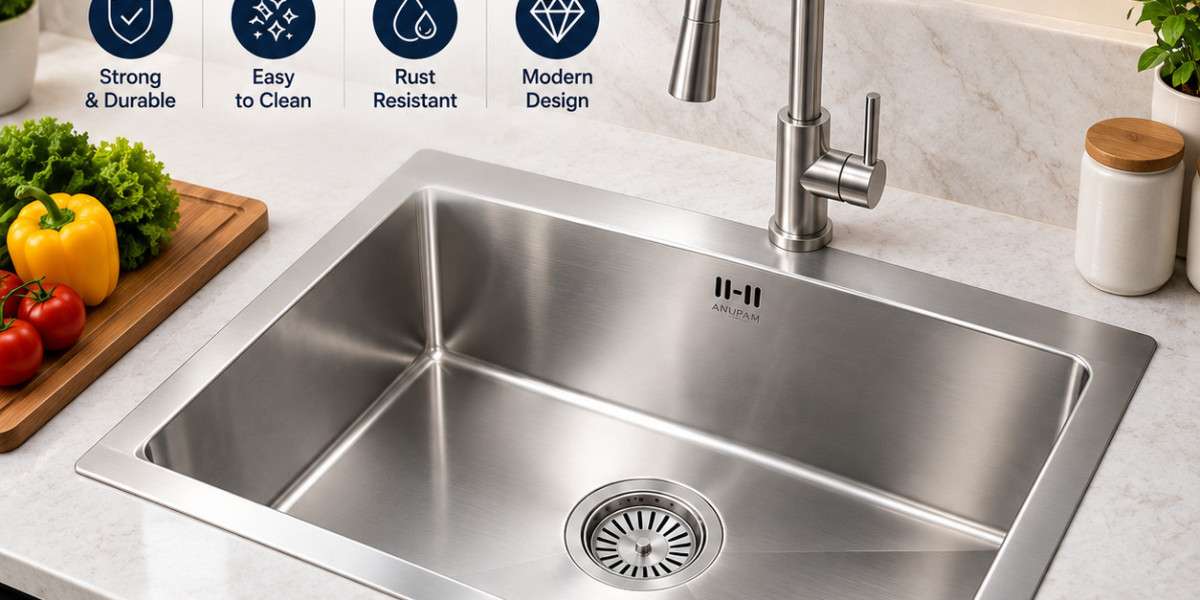
A kitchen sink may appear to be a simple basin, but manufacturing one involves material selection, metal forming, surface finishing, welding, dimensional control, and quality inspection. The manufacturing process has a direct influence on a sink's strength, appearance, drainage behaviour, and long-term usability.
For homeowners and kitchen professionals, understanding how sinks are made can make it easier to evaluate products based on measurable characteristics rather than appearance alone. Whether comparing a steel sink for kitchen, an ss sink for kitchen, or different types of sinks, looking beyond the surface can reveal important differences in construction and performance.
Choosing the Right Material for a Kitchen Sink
The material is one of the first factors considered during sink manufacturing. Stainless steel is widely used because it combines strength, formability, corrosion resistance, and relatively easy maintenance.
An ss sink for kitchen is generally manufactured from stainless steel sheet that is cut and shaped into the required basin configuration. The composition of the steel matters because alloying elements influence properties such as corrosion resistance, mechanical strength, and resistance to staining.
A commonly encountered stainless-steel family for kitchen applications is austenitic stainless steel. Its combination of ductility and corrosion resistance also makes it suitable for forming operations.
However, material grade alone does not determine the overall quality of a kitchen sink. Sheet thickness, forming quality, surface treatment, geometry, welding where applicable, and dimensional accuracy also contribute to the finished product.
From Stainless-Steel Sheet to Sink
The manufacturing process begins with stainless-steel sheet. The sheet must have suitable dimensions and mechanical properties for the intended forming process.
Depending on the sink design, manufacturers may use processes such as pressing, stamping, deep drawing, or a combination of forming operations.
During forming, controlled force is applied to transform a flat sheet into the three-dimensional shape of a basin. This requires careful control because excessive deformation can cause thinning, wrinkles, surface marks, or dimensional inaccuracies.
Deep drawing is particularly important for certain sink designs. In this process, a sheet is drawn into a die to create the basin shape. The metal flows into the required geometry rather than simply being bent at individual corners.
The design of the die, forming force, material properties, lubrication, and drawing depth all influence the result.
Why Sink Geometry Matters
The shape of a sink is not purely an aesthetic decision. Geometry affects structural stiffness, usable basin space, cleaning, and water movement.
Corners require particular attention during manufacturing. Very sharp transitions can create greater forming demands, while appropriately designed radii help distribute deformation more smoothly.
Pressed ribs, folds, edges, and reinforcing features can also increase stiffness without requiring a completely different material. This is an example of a basic engineering principle: geometry can influence structural performance as much as material selection.
For a sink for kitchen use, the finished basin must also maintain its intended dimensions after forming. Small dimensional variations can become important when the sink is installed into a precisely fabricated countertop.
Surface Finish and Stainless Steel
After forming, the surface of a stainless-steel sink may undergo finishing processes designed to achieve the required appearance and surface characteristics.
Common finishes include smooth, brushed, satin, or other textured appearances. Surface finishing can influence how visible fingerprints, water marks, and minor scratches are during normal use.
Finishing also requires process control. Uneven polishing or inconsistent surface treatment can create visible differences across the basin.
For consumers comparing a steel sink for kitchen, the finish should therefore be considered together with the underlying construction. A visually attractive surface does not automatically indicate better structural quality, just as a utilitarian finish does not necessarily indicate poor construction.
Welding and Joint Quality
Not every sink is manufactured as one continuous pressed piece. Some designs involve multiple components, which may require welding.
Welding joins metal components through a controlled heat-based process. The quality of the finished joint depends on factors such as material compatibility, welding parameters, preparation, and subsequent finishing.
Poorly controlled welding can affect appearance and may create areas requiring additional finishing. Quality control therefore needs to examine both the weld itself and the surrounding material.
Where a sink design uses welded components, consistent workmanship is important because joints become part of the finished product's structural and functional system.
Edge Formation and Structural Stability
The upper edge of a sink performs several functions. It contributes to appearance, handling, rigidity, and installation compatibility depending on the design.
Manufacturers therefore pay attention to edge dimensions and uniformity. An edge that is inconsistent or distorted can create difficulties during installation or affect how the sink sits against its supporting surface.
A properly formed edge also demonstrates the importance of dimensional control throughout the manufacturing process.
This is particularly relevant when comparing sinks that may look similar in photographs but have different manufacturing tolerances and construction details.
Quality Control During Manufacturing
Quality control is not limited to checking the finished product. It can occur at several stages of manufacturing.
Important checks may include:
- Stainless-steel sheet quality and dimensions
- Material thickness
- Basin dimensions
- Corner and edge consistency
- Surface finish
- Forming defects
- Weld quality where applicable
- Drain opening dimensions
- Overall shape and alignment
- Leakage or water-tightness
- Packaging and protection against surface damage
Dimensional inspection is particularly important because kitchen sinks must fit into a defined space. A sink can be visually attractive but still create practical problems if critical dimensions are outside the required tolerance.
Manufacturing tolerances are therefore an important technical concept. No manufactured component is perfectly identical to a mathematical drawing. Instead, acceptable dimensional limits are established around the target measurement.
Understanding Thickness Without Oversimplifying Quality
Thickness is frequently discussed when people compare a steel sink for kitchen. It can be a useful specification, but it should not be treated as the only measure of quality.
A thicker sheet can provide certain structural advantages, but the final performance also depends on the sink's geometry, forming process, support, reinforcement, and intended application.
For this reason, evaluating a sink for kitchen should involve several characteristics rather than focusing on a single specification.
Material grade, thickness, basin dimensions, construction method, finish, drain configuration, and manufacturing consistency provide a more complete picture.
How Manufacturing Influences Sink Price
Consumers often search for sink price before choosing a product. However, price differences can arise from several manufacturing and design variables.
Material cost is one factor, but it is not the only one. Product dimensions, steel thickness, forming complexity, number of components, finishing requirements, welding, quality inspection, packaging, and manufacturing volume can all influence production costs.
A more complex basin shape may require more specialised tooling or additional processing. Likewise, certain surface finishes require additional manufacturing steps.
Therefore, comparing sink price purely by external appearance may not provide a complete understanding of why two apparently similar products have different prices.
What Buyers Should Check Before Choosing a Sink
Understanding manufacturing helps turn product comparison into a more informed process. Before purchasing a kitchen sink, consider:
- Material: Check the stated stainless-steel grade where provided.
- Construction: Determine whether the basin is pressed, fabricated, or assembled from multiple components.
- Dimensions: Compare overall dimensions with the available countertop and cabinet space.
- Thickness: Treat sheet thickness as one specification rather than the sole quality indicator.
- Surface finish: Consider appearance as well as ease of everyday maintenance.
- Drain configuration: Check compatibility with the intended waste and plumbing arrangement.
- Quality information: Look for clear technical specifications rather than relying only on photographs.
- Warranty and documentation: Review the manufacturer's stated coverage and product information.
A Kitchen Sink Is a Manufactured Engineering Product
The everyday simplicity of a sink can hide a surprisingly detailed manufacturing process. From stainless-steel sheet selection to forming, finishing, dimensional inspection, and quality control, every stage can influence the finished product.
For anyone researching a steel sink for kitchen or an ss sink for kitchen, understanding these processes provides useful context when comparing specifications. It also explains why factors such as geometry, material, thickness, finish, and manufacturing tolerances should be considered together.
Ultimately, choosing a sink for kitchen use is not simply about appearance or sink price. A better evaluation considers how the product is constructed, what materials are used, how accurately it is manufactured, and whether its specifications match the requirements of the kitchen.
This manufacturing perspective allows buyers to assess sinks using practical engineering criteria and make comparisons based on information rather than assumptions.