
In today’s digital-first business environment, organizations depend on technology not only to support operations but also to drive growth, manage risk, protect information, and meet regulatory expectations. As technology becomes more complex, businesses need structured approaches for making sure IT delivers value while remaining secure, controlled, and aligned with business objectives.
This is where COBIT training becomes highly valuable.
COBIT is a widely recognized framework for the governance and management of enterprise information and technology. For IT professionals, auditors, risk specialists, compliance teams, managers, and aspiring technology leaders, learning the COBIT framework can provide a structured way to understand how technology decisions connect with organizational goals.
Whether you are completely new to COBIT or already working in IT governance, this guide explains what COBIT is, what you can learn through a COBIT 2019 training program, how certification works, and how the knowledge can support your professional development.
What Is COBIT?
COBIT stands for Control Objectives for Information and Related Technologies. It is a framework designed to help organizations govern and manage enterprise information and technology.
Rather than focusing only on technical systems, COBIT takes a broader business perspective. It helps organizations establish governance practices that address areas such as:
IT governance
Risk management
Information security
Compliance
Performance management
Business alignment
Technology resource management
Internal controls
Stakeholder needs
The framework is particularly useful because it provides a structured language for discussing technology governance between technical teams, executives, auditors, and business stakeholders.
What Is COBIT 2019?
COBIT 2019 is a modern version of the COBIT framework developed to address the changing requirements of digital organizations.
Compared with older approaches, COBIT 2019 provides greater flexibility for organizations dealing with cloud computing, cybersecurity, digital transformation, emerging technologies, regulatory requirements, and rapidly changing business environments.
A COBIT 2019 course generally introduces professionals to the framework’s governance and management concepts and explains how these concepts can be applied within different organizational environments.
The framework is not intended to force every organization into one rigid operating model. Instead, it can be adapted according to organizational priorities, risk profiles, regulatory requirements, and business objectives.
Why Is COBIT Training Important?
Technology investments can create significant business value, but they can also introduce operational, security, financial, and compliance risks. Organizations therefore need professionals who understand how technology should be governed.
A structured COBIT training program can help professionals understand the relationship between business goals, governance objectives, technology processes, risks, controls, and performance.
For example, an organization implementing a new cloud platform may need to consider:
Who is responsible for governance?
How will risks be identified?
What controls should be implemented?
How will performance be measured?
How should regulatory requirements be addressed?
How can technology investments support business objectives?
COBIT provides concepts that can help professionals approach these questions systematically.
COBIT 2019 Training: What Will You Learn?
A COBIT 2019 training program typically covers the fundamental concepts behind enterprise governance of information and technology.
Depending on the provider and course level, learners may study topics such as:
1. COBIT Principles
Understanding the principles behind the framework gives learners a foundation for applying COBIT appropriately.
2. Governance and Management
One important concept is the distinction between governance and management. Governance focuses on evaluating stakeholder needs, setting direction, and monitoring outcomes, while management involves planning, building, running, and monitoring activities in accordance with that direction.
3. Governance System and Components
COBIT 2019 introduces a governance system that includes different components organizations can use to create and maintain effective governance arrangements.
4. Goals Cascade
The goals cascade helps connect stakeholder needs with enterprise goals and governance and management objectives.
This connection is important because technology governance should ultimately contribute to organizational outcomes rather than operate independently from business priorities.
5. Performance Management
Professionals also learn how governance and management performance can be evaluated and monitored.
What Is a COBIT Course?
A COBIT course is a structured learning program designed to introduce participants to the concepts, principles, and practical application of COBIT.
Courses can differ considerably in depth. Some are designed for beginners who want a basic understanding of IT governance, while others are intended for professionals preparing for certification or applying COBIT within organizations.
When selecting a course, learners should consider:
Course level
Learning objectives
Certification preparation
Instructor expertise
Practical examples
Training duration
Assessment format
Professional relevance
A well-designed course should not simply explain terminology. It should help learners understand how COBIT concepts can be applied to real governance challenges.
Who Should Take COBIT 2019 Training?
One of the advantages of COBIT is that its concepts can be relevant to professionals across multiple technology and business functions.
A COBIT 2019 course may be particularly useful for:
IT managers
IT governance professionals
IT auditors
Risk management professionals
Compliance specialists
Information security professionals
Technology consultants
Internal control specialists
Project and program managers
Business technology leaders
IT professionals interested in governance
You do not necessarily need to be an experienced auditor or technology manager to begin learning COBIT. Beginners can start with fundamental concepts and gradually build more advanced knowledge.
COBIT 2019 Certification Explained
For professionals who want formal recognition of their knowledge, COBIT 2019 certification can be an important credential.
Certification demonstrates that a professional has studied the relevant COBIT concepts and successfully completed the applicable assessment requirements for the certification level.
The certification path can help learners establish a structured progression from foundational understanding toward more advanced knowledge.
Before enrolling, candidates should review the current certification requirements, examination structure, eligibility conditions, and official guidance applicable to the credential they intend to pursue.
COBIT Training vs. COBIT Certification
It is useful to understand the difference between training and certification.
COBIT training is the learning process. It gives you the knowledge and understanding needed to work with the framework.
COBIT certification is a formal credential earned after meeting the requirements associated with a particular certification.
In simple terms:
Training helps you learn. Certification validates your knowledge.
Some professionals may take a COBIT course simply to strengthen their understanding of IT governance without immediately pursuing certification. Others may use training specifically as preparation for a certification examination.
Both approaches can be useful depending on your career objectives.
How COBIT Framework Supports IT Governance
The COBIT framework provides a structured approach for organizations seeking stronger governance of information and technology.
Consider an organization with multiple technology departments, cybersecurity requirements, compliance obligations, and significant technology investments. Without clear governance, different teams may establish inconsistent processes or make decisions that do not fully support business priorities.
COBIT can help organizations establish a more structured governance approach by connecting:
Stakeholder needs → Enterprise goals → Governance and management objectives → Processes and activities → Performance measurement
This relationship helps organizations view technology as an integral part of business governance rather than as an isolated technical function.
COBIT and Risk Management
Risk is an essential part of technology governance.
Organizations face risks related to cybersecurity incidents, system availability, privacy, third-party providers, regulatory requirements, data quality, technology changes, and operational failures.
COBIT can support organizations in establishing governance practices that take these risks into consideration.
For professionals working in risk management, studying COBIT can therefore provide another perspective on how technology-related risks can be incorporated into broader enterprise governance.
The framework can also complement other standards, frameworks, and organizational practices rather than necessarily replacing them.
COBIT and Cybersecurity
Cybersecurity has become a central concern for organizations of every size. However, cybersecurity is not only a technical problem.
Organizations also need effective policies, accountability, risk management, controls, monitoring, and decision-making.
This is one reason professionals working in cybersecurity may find COBIT 2019 training valuable. The framework encourages a governance-oriented perspective that can help connect security activities with business requirements.
For example, security teams may focus on technical controls, while executives need to understand business risk, regulatory exposure, investment priorities, and organizational responsibilities. Governance frameworks can help create a common structure for these discussions.
COBIT for IT Auditors and Compliance Professionals
IT auditors frequently evaluate whether technology processes, controls, and governance arrangements are working as intended.
A strong understanding of COBIT can provide useful governance concepts for professionals working in audit and assurance environments.
Similarly, compliance professionals can benefit from understanding how technology governance relates to organizational objectives, risk, controls, and accountability.
However, COBIT should be viewed as a framework for governance and management, not simply as an audit checklist.
Its broader value comes from understanding how technology-related activities contribute to organizational outcomes.
Benefits of Taking a COBIT Course
There are several reasons professionals choose to study COBIT.
Better Understanding of IT Governance
A course can provide a structured introduction to governance concepts that may otherwise seem fragmented.
Stronger Risk Awareness
Learners gain a governance-oriented perspective on technology risks and controls.
Improved Business-IT Alignment
COBIT emphasizes the relationship between business goals and technology governance, helping professionals understand why technology decisions should support organizational objectives.
Professional Development
Adding COBIT knowledge to an existing IT, audit, security, risk, or compliance background can broaden a professional skill set.
Preparation for Certification
For candidates pursuing COBIT 2019 certification, structured training can provide a foundation for studying the relevant concepts and preparing for assessment.
How to Choose the Right COBIT 2019 Course
Not every training program will have the same structure or depth. Before enrolling in a COBIT 2019 course, consider what you actually want to achieve.
If you are a beginner, look for a course that explains fundamental concepts clearly and progressively.
If you already work in IT governance, audit, risk, or compliance, consider training that includes practical application and more advanced framework concepts.
You should also evaluate:
Course curriculum
Instructor qualifications
Learning format
Certification preparation
Practical examples
Study resources
Assessment support
Course duration
The best choice depends on your existing experience and professional objectives.
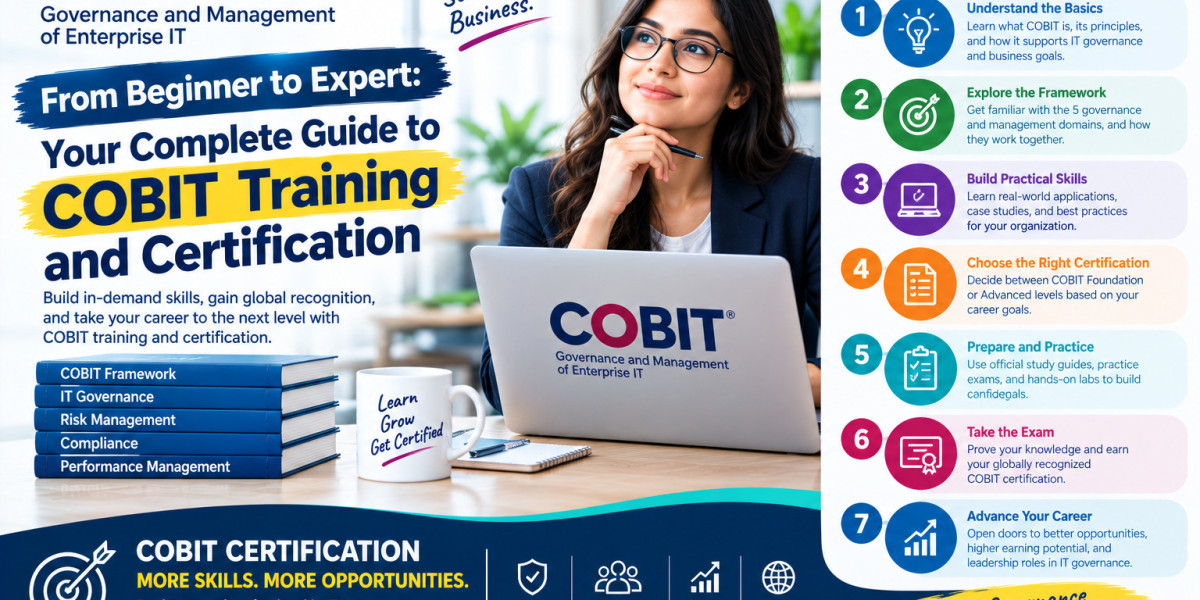
A Practical Learning Path From Beginner to Expert
You do not need to master the entire framework immediately.
A practical learning journey can begin with understanding what COBIT is and why IT governance matters.
Next, study COBIT 2019 principles, governance and management concepts, components, objectives, and the goals cascade.
After developing a solid foundation, move toward practical application. Think about how the framework could be used to address real organizational challenges involving technology risk, compliance, performance, cybersecurity, and business alignment.
Finally, professionals can deepen their knowledge through advanced study, professional experience, certification, and practical implementation.
The key is to combine theory with application.
COBIT Course From GI Intelligence
If you are looking for structured professional development in COBIT, GI Intelligence offers a dedicated COBIT course designed to help professionals build knowledge around the framework and its application.
You can explore the COBIT course from GI Intelligence to learn more about the program, course content, and training information. It can be a useful starting point for professionals who want to develop their understanding of COBIT 2019, IT governance, risk, compliance, and technology management.
Is COBIT Certification Worth Pursuing for IT Professionals?
The value of a professional certification depends on your career direction, current experience, and the type of roles you want to pursue.
For someone working in IT governance, audit, risk, compliance, cybersecurity, or technology management, COBIT knowledge can complement existing technical and professional skills.
It can also help professionals develop a more structured understanding of how technology decisions, governance responsibilities, risks, controls, and business objectives interact.
Rather than treating certification as the end goal, professionals can gain greater value by applying what they learn to actual workplace challenges.
How to Prepare for COBIT 2019 Certification
If your objective is COBIT 2019 certification, preparation should begin with a clear understanding of the official examination requirements.
A structured approach can include:
Learn the fundamental COBIT terminology.
Understand the principles and governance concepts.
Study the COBIT 2019 governance system.
Understand governance and management objectives.
Review the goals cascade.
Study performance management concepts.
Use structured training materials.
Practice applying concepts to realistic scenarios.
Review difficult topics repeatedly.
Follow the current certification provider's examination guidance.
Instead of memorizing isolated definitions, focus on understanding why each concept exists and how it relates to governance objectives.
Common Mistakes Beginners Make When Learning COBIT
New learners sometimes approach COBIT as though it were simply another technical methodology.
That can make the framework more difficult to understand.
COBIT is broader than a collection of technical procedures. Its purpose is connected to governance and management of enterprise information and technology.
Another common mistake is trying to memorize everything before understanding the framework's overall structure.
A better approach is to first understand the big picture and then study individual concepts in greater depth.
Finally, learners should avoid assuming that COBIT must be implemented identically in every organization. Its concepts can be adapted to organizational context and requirements.
Final Thoughts: Building Your COBIT Knowledge
COBIT training can provide IT professionals with a structured way to understand technology governance, risk, controls, compliance, performance, and business alignment. Whether you are starting from scratch or already working in IT governance, audit, cybersecurity, risk, or compliance, learning the COBIT framework can broaden your professional perspective.
A well-structured COBIT 2019 training program can help you build foundational knowledge, while a COBIT 2019 certification can provide formal recognition of your understanding. The most important step, however, is learning how to connect framework concepts with real organizational challenges.
If your goal is to progress from beginner knowledge toward professional-level understanding, starting with a comprehensive COBIT course and gradually developing practical experience can give you a clear learning path. For professionals interested in beginning that journey, the COBIT training program from GI Intelligence provides a dedicated starting point for exploring the framework and developing relevant skills.






