
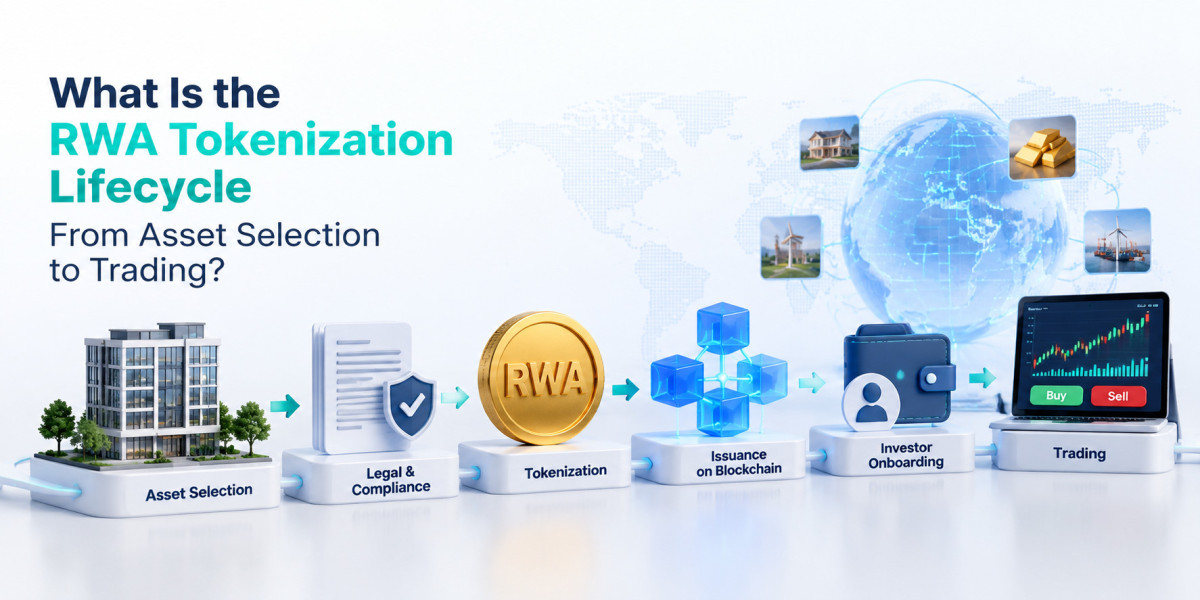
Real-world asset (RWA) tokenization is the process of representing ownership, rights, or economic interests in physical or traditionally off-chain assets through blockchain-based tokens. These assets can include real estate, government securities, private credit, commodities, artwork, funds, and other financial or tangible assets.
The concept has moved beyond experimentation as financial institutions, asset managers, fintech companies, and blockchain businesses explore tokenized markets. The attraction is straightforward: blockchain infrastructure can automate parts of issuance, recordkeeping, transfers, compliance, and settlement while creating new ways to distribute assets.
However, tokenization is not simply a matter of creating a token and listing it on a marketplace. A successful project requires a lifecycle that connects the underlying asset with legal ownership, valuation, compliance, smart contracts, investor onboarding, custody, issuance, and secondary trading. Understanding this lifecycle is therefore essential for businesses planning an RWA tokenization project.
1. Asset Selection and Feasibility Assessment
The lifecycle begins by identifying an asset that can reasonably be represented through blockchain infrastructure. Asset selection is more important than it may initially appear because the characteristics of the underlying asset determine the legal structure, valuation model, investor requirements, custody arrangements, and potential trading environment.
Businesses commonly evaluate assets such as income-generating real estate, short-term government securities, private credit, commodities, investment funds, and other assets with identifiable ownership and measurable economic value.
The first assessment generally considers several questions. Who legally owns the asset? Can ownership or economic rights be transferred? How is the asset valued? Does it generate income? What documentation proves its existence and ownership? Who will hold the underlying asset after tokenization? What jurisdiction governs it?
For example, suppose a company wants to tokenize a commercial property worth $20 million. Before issuing tokens, it must establish the property's legal ownership, valuation, debt obligations, rental income, taxes, insurance, and transfer restrictions. Tokenization technology cannot resolve weaknesses in the underlying asset structure.
This is why due diligence should precede blockchain development. A technically sophisticated token representing an asset with unclear ownership or inadequate documentation creates significant legal and operational risks.
2. Legal Structuring and Regulatory Analysis
Once an asset passes the feasibility assessment, the next stage is designing its legal structure. This stage connects the digital token to the real-world rights it represents.
Depending on the jurisdiction and asset type, the token may represent direct ownership, shares in a legal entity that owns the asset, a debt claim, fund interests, revenue rights, or another contractual interest. The appropriate structure depends on applicable securities, property, tax, financial-services, and digital-asset regulations.
For businesses entering this stage, compliance should be treated as part of the product architecture rather than an activity performed after development. Investor eligibility, transfer restrictions, identity verification, anti-money-laundering requirements, disclosures, reporting, custody, and recordkeeping can all influence how the platform is designed.
A project may therefore need legal counsel, compliance specialists, tax professionals, asset managers, custodians, and blockchain developers working together.
This stage is also where businesses may evaluate Secure RWA Tokenization Services, Blockchain RWA Tokenization Services to build the technical infrastructure around the project's legal and compliance requirements.
The legal structure ultimately determines what investors actually receive when they purchase a token. That distinction matters because owning a blockchain token does not automatically mean owning the underlying physical asset.
3. Asset Valuation and Documentation
After establishing the legal framework, the underlying asset must be documented and valued.
For financial assets, valuation may involve market prices, credit assessments, interest rates, maturity dates, and other financial data. For real estate, valuation can involve comparable transactions, rental income, occupancy, location, development potential, and independent appraisal reports.
Documentation provides the evidence connecting the tokenized representation to the underlying asset. Depending on the project, this can include:
- Ownership documents
- Independent valuation reports
- Financial statements
- Property records
- Custody agreements
- Insurance documentation
- Legal contracts
- Investor disclosures
This information can also support ongoing transparency after issuance.
Consider a tokenized real estate project where investors receive economic exposure to rental income. Investors need more than a token balance in a wallet. They may require information about property ownership, rental performance, expenses, distributions, valuation updates, and relevant legal arrangements.
Consequently, data management becomes an important part of RWA infrastructure.
4. Choosing the Blockchain and Designing the Token
With the asset and legal structure established, the project can move toward blockchain architecture.
The blockchain should be selected according to the project's requirements rather than simply based on popularity. Businesses may evaluate transaction costs, throughput, ecosystem maturity, wallet support, interoperability, privacy requirements, smart-contract capabilities, institutional adoption, and regulatory considerations.
The token itself must also be designed according to the rights attached to the underlying asset.
For example, tokens may be structured to represent:
- Ownership interests
- Debt claims
- Revenue-sharing rights
- Fund interests
- Access or usage rights
- Fractional interests in an asset
Smart contracts can encode specific rules governing issuance, transfers, distributions, and other functions. However, not every legal requirement should be assumed to exist automatically inside a smart contract. Some obligations still depend on legal agreements, regulated intermediaries, custodians, administrators, and off-chain processes.
The strongest RWA systems therefore combine blockchain automation with conventional legal and financial infrastructure.
5. Smart Contract Development and Testing
The smart contract becomes the operational layer for many tokenization platforms. It can manage token creation, supply limits, ownership records, transfers, distributions, and restrictions.
For regulated or permissioned assets, the contract may incorporate mechanisms that prevent transfers to unauthorized wallets. Whitelisting, role-based permissions, transfer controls, pause mechanisms, and compliance checks can be implemented where appropriate.
Security testing is particularly important because smart-contract vulnerabilities can affect assets with substantial real-world value.
A development team may conduct code reviews, automated testing, unit testing, integration testing, and independent security audits. The contract should also be tested against abnormal scenarios, including unauthorized transfers, incorrect permissions, failed transactions, and unexpected administrative actions.
The goal is not merely to make the token function. It is to ensure that the blockchain layer accurately reflects the intended business and legal rules.
6. Investor Onboarding and Compliance
Before investors can acquire many types of tokenized assets, they may need to complete identity and eligibility checks.
A typical onboarding process can include identity verification, KYC procedures, AML screening, investor classification, sanctions screening, accreditation or suitability checks where applicable, and acceptance of relevant agreements.
This stage creates an important connection between traditional compliance systems and blockchain wallets.
For example, a platform could approve an investor through its compliance system and associate the approved investor identity with a permitted wallet address. The blockchain can then enforce transfer restrictions based on the platform's rules.
The exact process varies considerably by jurisdiction and asset type. This is one reason why RWA platforms need configurable compliance infrastructure instead of assuming that a single onboarding model works globally.
7. Token Issuance and Primary Distribution
Once the asset, legal framework, smart contracts, and compliance processes are ready, tokens can be issued.
Issuance involves creating the defined token supply and distributing tokens to eligible investors according to the project's terms. The platform may also provide investor dashboards showing holdings, transaction history, distributions, asset information, and relevant documents.
Fractionalization is one of the frequently discussed advantages of tokenization. An asset worth $10 million could theoretically be divided into a large number of smaller token units. However, fractionalization does not automatically guarantee liquidity or broad investor access. Legal restrictions, minimum investment requirements, market demand, and platform design still matter.
The primary issuance stage is therefore where the project's technical architecture begins interacting with actual investors and capital.
8. Custody and Linking Tokens to Real-World Assets
One of the most important characteristics of RWA tokenization is the connection between an on-chain representation and an off-chain asset.
If tokens represent a property, for example, there must be a legally enforceable arrangement establishing what happens to that property and who controls it. If tokens represent government securities, an appropriate custody and settlement structure must exist for the underlying securities.
This creates what is often described as the "oracle" or asset-verification challenge. Blockchain networks can verify transactions occurring on-chain, but they cannot independently determine whether a building still exists, whether rent was paid, or whether a physical commodity remains in custody.
Reliable RWA infrastructure therefore requires trusted data sources, custodians, administrators, auditors, legal entities, or other mechanisms that maintain the connection between the digital token and its underlying asset.
9. Secondary Market and Trading
After primary issuance, the lifecycle can progress into secondary trading.
A secondary market allows eligible token holders to transfer or sell their positions to other eligible participants. Depending on the asset and regulatory structure, trading may occur through a dedicated marketplace, regulated platform, peer-to-peer infrastructure, or another approved venue.
This is where the frequently discussed liquidity potential of tokenization becomes relevant. Traditional assets such as private credit, real estate, or certain investment interests can be difficult to transfer quickly. Blockchain-based representations can make transfer and settlement more programmable, but actual liquidity still depends on buyers and sellers being available.
In other words, tokenization can improve the infrastructure for transferring an asset, but it cannot manufacture market demand.
Trading systems may therefore include order management, wallet connectivity, compliance checks, transaction monitoring, settlement mechanisms, and transfer restrictions.
10. Settlement, Ownership Records, and Reporting
Once a trade occurs, the platform needs to update ownership records and complete settlement.
Blockchain networks can provide a shared transaction record, potentially reducing reconciliation between different databases. Smart contracts can also automate parts of settlement where the necessary conditions have been met.
However, RWA platforms often require more than blockchain transaction records. Investors may need tax statements, distribution reports, valuation updates, regulatory disclosures, and financial statements.
For example, if a tokenized property generates monthly rental income, the platform may need to calculate the distributable amount, account for expenses, determine eligible token holders, and distribute the corresponding amount.
This demonstrates why RWA tokenization is better understood as an ongoing financial infrastructure process rather than a one-time token issuance.
11. Ongoing Asset Management and Compliance
The lifecycle does not end when trading begins. Tokenized assets require continuous management.
Property values can change. Interest rates can move. Tenants can leave buildings. Debt can mature. Regulations can change. Investors can transfer tokens. Corporate actions can occur.
Platforms must therefore maintain accurate asset data and update investor information throughout the asset's life.
Ongoing responsibilities can include:
- Asset valuation updates
- Regulatory reporting
- Investor communications
- Compliance monitoring
- Distribution management
- Smart-contract administration
- Custody reconciliation
- Transaction monitoring
- Security maintenance
This ongoing layer is essential because the token's value remains connected to the performance and legal status of the underlying asset.
Real-World Example: Tokenized U.S. Treasuries
Tokenized U.S. Treasury products provide a useful example of how the lifecycle can work. Instead of representing a building or commodity, the token can provide exposure to a pool or structure backed by U.S. Treasury securities.
The process still requires an underlying asset, a legal structure, custody, valuation, token issuance, investor onboarding, and mechanisms for transferring the token.
The example demonstrates an important principle: RWA tokenization does not eliminate traditional financial infrastructure. It connects that infrastructure with blockchain-based settlement and ownership systems.
Why the Lifecycle Matters
Every stage of RWA tokenization affects the next. Poor asset selection can create legal problems. Weak legal structuring can undermine investor confidence. Poor documentation can make asset verification difficult. Insecure smart contracts can expose funds to technical risks. Inadequate compliance can restrict distribution or create regulatory exposure.
A successful project therefore needs coordination across legal, financial, technological, and operational layers.
The most effective approach is to begin with the asset and its economic purpose, then design the legal and technical architecture around it. Starting with a token standard and trying to fit an asset into it later can produce unnecessary complications.
Conclusion
The RWA tokenization lifecycle extends from asset selection and due diligence to legal structuring, valuation, token design, smart-contract development, investor onboarding, issuance, custody, trading, settlement, and ongoing compliance. Each stage connects blockchain technology with established financial and legal processes. As tokenized markets develop, businesses that approach the lifecycle as an integrated infrastructure project can better address security, transparency, compliance, and operational requirements. Blockchain App Factory provides best services for businesses exploring RWA tokenization, helping build customized blockchain-based solutions around their asset, platform, and business requirements.






