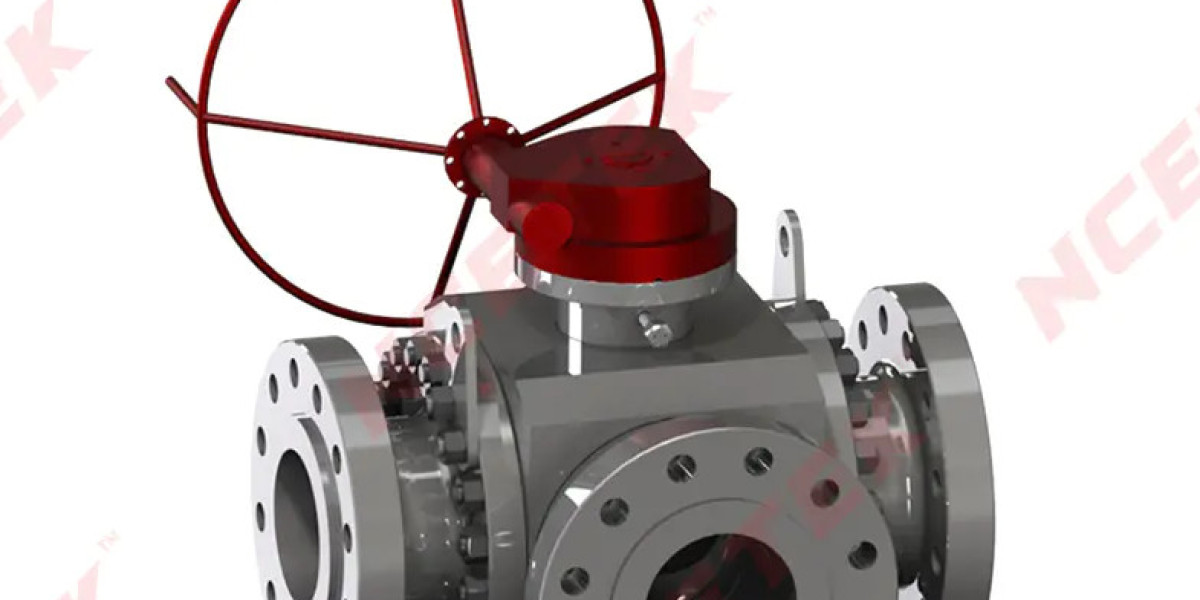
Industrial pipelines often require valves that can manage substantial pressure and mechanical loads while maintaining reliable isolation. In these systems, the relationship between body construction, ball support, sealing design, and actuator operation becomes especially important. A Cast Steel Trunnion Mounted Ball Valve uses a supported ball structure to distribute operating loads and reduce the amount of force transferred to the stem. This design can be suitable for larger pipelines, higher pressure differentials, and applications where consistent operation is important.
The cast steel body forms the pressure boundary and provides protection for the internal mechanism. Casting allows manufacturers to create complex internal passages, connection areas, and external body shapes. However, the process must be controlled carefully. Mold accuracy, molten metal quality, pouring conditions, cooling, heat treatment, and post-casting inspection all influence the final body. Potential defects such as porosity, inclusions, shrinkage, or dimensional variation may affect pressure containment and assembly accuracy.
Material selection should reflect the operating medium and the external environment. Carbon steel may be suitable for many general industrial pipelines. Stainless steel can be considered where corrosion resistance is important, while alloy steel may be selected for higher temperatures or demanding mechanical conditions. The body material must be reviewed together with the ball, trunnions, stem, seats, bearings, and fasteners. Differences in hardness, thermal expansion, or chemical compatibility can influence the performance of the complete assembly.
The trunnion mounted structure supports the ball through fixed upper and lower points. This arrangement limits ball movement and reduces the load carried by the stem. Lower operating torque can make actuator selection more manageable, particularly in larger valves or systems with significant pressure differentials. The support system must be accurately aligned, because uneven loading may create friction, abnormal wear, or difficulty completing the operating cycle.
The ball and trunnion components require precise machining. The ball surface must maintain suitable roundness and finish so that it can interact consistently with the seats. The trunnions, bearings, stem connection, and seat pockets must also be manufactured within appropriate tolerances. If the components are not concentric, the valve may experience uneven contact or increased torque. Precision machining is therefore not limited to the ball itself; it extends across the complete internal structure.
Seat design is central to the sealing function. Trunnion mounted ball valves may use spring-loaded seats, pressure-assisted seats, soft seats, or metal seated arrangements. The appropriate design depends on the medium, pressure, temperature, and required isolation performance. Soft seats may provide effective sealing in compatible services, while metal seated structures may be considered for high-temperature, abrasive, or solid-containing media.
Seat materials must resist deformation, wear, and chemical attack. Spring loading can help maintain contact when pressure conditions change, while pressure-assisted sealing may improve contact under certain operating conditions. The design should also consider trapped cavity pressure and the need for pressure relief or monitoring. These details become more important in systems where isolation reliability is essential.
The stem and actuator connection must be designed according to the actual operating torque. Valve size alone does not determine actuator requirements. Seat loading, pressure differential, friction, temperature, and operating frequency all affect the force required to rotate the ball. Manual gearboxes, pneumatic actuators, electric actuators, and hydraulic systems may be selected according to the installation and control requirements.
Manufacturing quality also depends on assembly cleanliness and controlled fastening. Foreign particles can damage the ball or seats, while uneven tightening may distort body components. Fasteners should be tightened according to a controlled procedure, and the body sections should remain correctly aligned. The stem packing should be compressed sufficiently to reduce external leakage without creating unnecessary operating resistance.
Testing helps confirm the integrity and function of the finished valve. Body pressure testing evaluates the pressure boundary, while seat testing examines shutoff performance. Functional testing verifies that the ball can complete its intended movement and that the actuator or manual operator responds correctly. Additional inspections may include dimensional checks, material verification, visual examination, hardness testing, and non-destructive examination.
Installation and maintenance should be considered during project planning. Pipeline supports should prevent excessive external loads from being transferred to the valve. The line should be cleaned before commissioning, and the valve should be operated carefully through its full travel. During service, operators should monitor changes in torque, external leakage, actuator response, and seat behavior. If the medium contains abrasive particles, filtration and cleaning procedures may help reduce internal wear.
A Cast Steel Trunnion Mounted Ball Valve should be evaluated according to its body quality, support structure, seat arrangement, machining accuracy, actuator compatibility, inspection records, and maintenance access. Industrial users can review relevant valve designs through https://www.ncevalve.com/product/ when comparing equipment for demanding pipeline and process applications.